
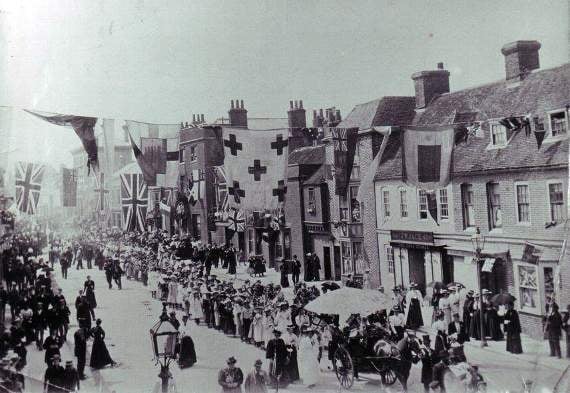
Petersfield High Street is changing, as are many high streets in small towns around the country.
Shops and businesses are closing or changing hands – and great discussion can be heard around the causes of this change and the benefits or pitfalls of what is happening.
This changing landscape of the high street is not new and when we look into the history of Petersfield’s high street we see many changes occurring over the years.
The census of 1981 estimates that not more than 50 people were resident on the High Street – that is just 0.5 per cent of the 10,000 population of the town at that time.

.png?width=209&height=140&crop=209:145,smart&quality=75)
When the first detailed census was taken in 1841 some 245 people were resident on the High Street, which was 16.3 per cent of the 1,500 population.
This difference is a result of the custom of ‘living over the shop’, something which dropped off in the 20th and 21st centuries.
When every property was also a dwelling, the households comprised the proprietor, his family, servants and apprentices.
Living-in domestic servants were a normal part of the household for all but the most humble. In 1851 about 20 per cent of all inhabitants were domestic servants, mostly young teenage girls.
This partly accounted for the higher proportion of females in the total population of the High Street, with seven out of ten residents in 1851 being female.
This ratio was also helped by the presence of two boarding schools for girls on the High Street and a couple of women-only households with private income.
As well as servants, apprentices also lived with the proprietor and his family.
Mr Goble, a draper, had six living-in assistants in 1881.
Traditionally the occupation of those living on the High Street reflected the various trades and services required by the hinterland of a small market town.
A wide social spectrum was covered, with some gentry and professions such as lawyers and surgeons.
Alongside these households flourished those engaged in commerce.
These included clothiers, saddlers, fellmongers, glovers, cordwainers and butchers.
Over time these traditional trades were joined by new businesses.
A tobacconist appeared in the 17th century.
Booksellers, printers, milliners and school mistresses started appearing in the 18th century.
The 1841 census had 20 different callings represented in the High Street.
This number had grown to 31 in 1861.
Over time this number has fallen as a result of two main factors.
One is Petersfield’s expansion, which has seen businesses move away from the High Street to other areas of the town.
The other is increasing prosperity and the development of desirable housing areas, which have made living away from the shop or office possible.
The changes that have happened in the High Street are captured in the retiring of Dr Jeffries in 1952.
This ended the tradition of a medical practice being present on the High Street since the latter part of the 17th century.
It is true that the High Street is changing.
Whether for the better or for worse is not for us to say.
But what we can say is that change has always happened and the changing face of Petersfield High Street is not a new phenomenon.