
Autumn is definitely here, with the cold nights and heavy dew on the ground – and when I was walking through town the other day the wind was a bit blowy and the leaves were falling like snow.
I have said before that spring and the vibrant green of everything is my favourite time of year, but autumn definitely comes a close second.
There is a brown tourist sign after the Hindhead Tunnel reading ‘Canadian Memorial Planting’ and small car park for visitors.
 Dazzling Christmas convoy to hit the road as Tractor Run returns to Petersfield area
 Bohunt School soars to top 20 in UK national league tables
 Shoplifter banned from wearing wigs after series of thefts across East Hampshire
 East Hampshire road closures: almost a dozen for motorists to avoid over the next fortnight
This gives access to the avenue of maple trees brought from Canada and planted on Bramshott Common.
They commemorate Canadian servicemen who were trained locally and died at Bramshott during the First and Second World Wars.
In autumn the trees provide a glorious spectacle of colour, and are well worth a visit if you get the chance!
Back on the allotment, October and November are good months for some serious digging when the ground is not too wet.
The deeper the fertile soil, the better crops that can be had.
Double digging is when you dig a trench and break up the sub-soil with a fork.
Then add a good layer of manure or compost and place the soil from the next trench on top.
This will greatly improve your soil; it’s a lot of hard work but worth the long-term benefits.
This time of year I dig over my empty plots and put a good couple of inches of manure on them.
I then cover them with horticultural fabric to discourage weeds and encourage the worms to do their magic!
In the spring I will rotavate them ready for planting.
Now is also the time to concentrate on your compost making.
The last of the bulk foliage should be available to build a proper heap rather than a waste pile.
Emptying one bin into another, layering with nitrogen rich manure as it builds, will ensure decomposition gets off to a good start.
It’s beneficial to chop up your waste so if you have access to a chipper it’s the perfect tool to get your garden waste as small as possible.
Or running a mower over it will do the trick or do as I did the other day when my bin was full of pumpkin and squash foliage. I used a sharp spade to break it all down – but I got some funny looks as I was stood on top of my bins!
I also use some old natural fibre carpet to cover the bin to help retain some of the heat.
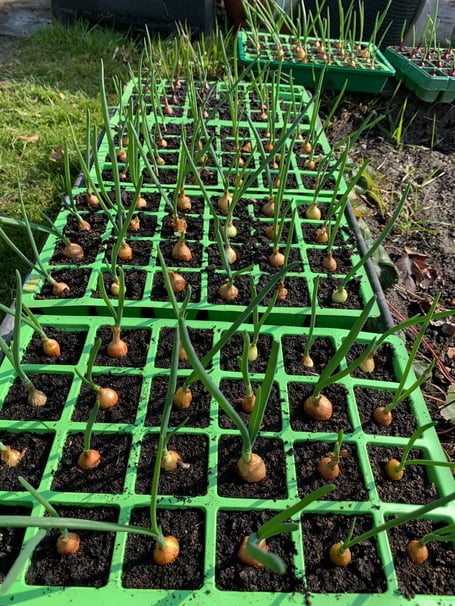
October is the time to be thinking about planting your over-wintering onions. The easiest way to grow onions is from sets and what I do firstly is fill a 24-cell tray with a general-purpose compost.
I then pop a set in each of the cells, keep the compost moist, but not wet, and within a week or so they will start shooting.
I do this to give them the best start and when you plant them like this the birds are less likely to pull them up!
When the roots are poking through the bottom of the tray, it’s time to plant them in your onion bed.
An onion bed needs to be well draining and have been dug over and prepared with a good amount of well-rotted organic matter as onions are big fans of high-nitrogen soil.
Plant them about 10cm apart and with 20cm to 30cm between each row, then leave them to it, watering only in really dry spells in the autumn. They should be ready for harvest in early July.
Comments
This article has no comments yet. Be the first to leave a comment.