
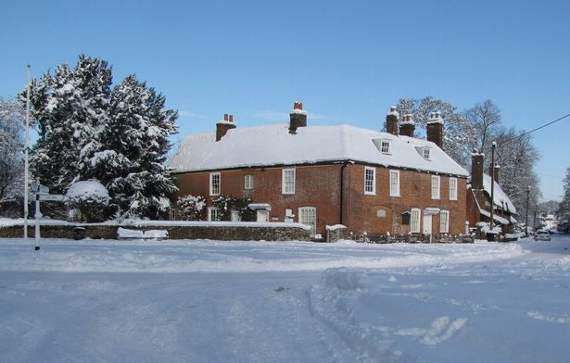
It was so lovely to be able to go and look around the home of world-famous novelist Jane Austen in Chawton, writes retired NHS worker Jane Bartlett.
Austen, a socially-observant author of romantic novels, was born on December 16, 1775, and is credited with being the first woman to put quill to parchment and write what would be best-selling novels; books that have been in print ever since she penned them. Her talent was sadly lost when she died aged just 41 on July 18, 1817.
As an avid lover of her books, being able to visit what is described as the ‘most treasured Austen site in the world’ was a real joy.
I was lucky enough to be met and shown around the house near Alton by Lizzie Dunfold, the director of Jane Austen’s House Museum.




It had been cold the night before my visit, and walking up the frosty path I felt shivers of anticipation.
But going straight into the beautifully-recreated and warm kitchen of the 17th century cottage was such a cosy feeling.
Jane, her sister Cassandra, their mother, also Cassandra, and close family friend, Martha Lloyd, all shared the cottage on the junction of the-then busy roads to Winchester, Petersfield and Gosport.
From a discreet speaker in the kitchen actress Dame Emma Thompson recited a family favourite recipe, lemon mince pies.
It was so atmospheric; I felt transported back to the 19th century.
Martha really loved cooking, and collected recipes from family and friends, as well as making up her own delicious creations – such as lemon mince pies!
They have since been published under the name Martha Lloyd’s Household Book.
Lizzie said the family wouldn’t have spent much time in the kitchen, but would have helped at busy times – such as harvest time – even making spruce beer from the buds, needles or essence of spruce trees.
And it was very much a female household – Jane was fiercely independent, choosing to remain single.
But she did accept a suitor’s offer of marriage two weeks before her 27th birthday – only to withdraw her agreement the very next morning!
And it is thought her sister Cassandra never recovered from the death of her fiance Tom Fowle, and never married despite living to the age of 72.
Next to the kitchen is the drawing room with its warming open fire.
It was in this room that on an evening in 1813 Jane and her mother read some of Pride and Prejudice to Miss Benn, a family friend who lived nearby.
The novel came to be one of the most read in the English language, but Miss Benn was unaware Jane wrote it – her thoughts about the fireside recitation aren’t known!
But how wonderful to have Jane herself reading one of her great novels to you!
In the corner is a piano, and Jane’s beloved father’s serious mahogany bureau and bookcase is also there.
As a child she would watch him writing at it at the family home in north Hampshire, Steventon Rectory.
Her father encouraged Jane to write, and even sent one of her early stories to a publisher saying it was a whole new style of writing.
The publisher declined the story – I bet he kicked himself later!
One of Jane’s daily chores at Chawton was to lay up the dining table and make breakfast for her sister and mother.
In the beautifully-recaptured dining room, it was easy to see them enjoying their first meal of the day; by the window was Jane’s circular writing table, so much smaller than I imagined.
She would start writing after breakfast, and looking up from her writing would have seen through the window the stagecoaches rattling along the busy road outside.
Almost as soon as she arrived at Chawton in 1809 her creative juices started flowing; it’s amazing to think that in the eight years before her death she wrote all six of her novels there.
As well as reciting recipes, Dame Thompson narrates Jane’s novels in other rooms.
It’s a great idea – if you close your eyes it’s easy to imagine Jane reading her manuscripts out loud to herself !
Going up the narrow creaking stairs you could picture the family turning into bed after a busy day.
In the sisters’ shared bedroom there were replicas of Jane’s bed and one of her gowns. Another bedroom has seafaring paintings on the walls, and the Austen family tree; two of her brothers, Francis and Charles, were Royal Navy admirals.
Francis enforced the 1807 Abolition of Slavery Act in the Caribbean, and his letters reveal his disgust with slavery.
Jane, who was extremely close to all her brothers, almost certainly shared his views.
Next door were presents of topaz crosses to Cassandra and Jane from Charles, and a delicate turquoise ring of Jane’s.
There was also an exquisite muslin shawl delicately embroidered with tiny crosses by Jane.
But my favourite was a gorgeous and beautifully-designed quilt of more than 3,000 diamond-shaped panels hand stitched by Jane, Cassandra and their mother.
In the courtyard outside, the bakehouse has an impressive bread oven and a huge copper for heating water and brewing beer.
It is believed Jane enjoyed a tipple. In 1813 she wrote to Cassandra: “As I must leave off being young, I find many douceurs (pleasures) in being a sort of chaperon for I am put on a sofa near the fire and can drink as much wine as I like.”
On the way to the museum’s delightful shop was a donkey cart; Jane would often drive her niece and nephews in it, or use it to visit friends, or do the shopping.
When I was saying my goodbyes to Lizzie, she said she thought Jane would have been amazed to have become a household name for her books, largely unacknowledged or read while she was alive, but now enjoyed worldwide!
The Chawton farmhouse was Jane’s final home; she lived there from 1809 until her death in 1817, and wrote and revised her six beloved novels there. Today it is a small independent museum celebrating her life.
It was originally home to local farmers, but between 1781 and 1787 it was pub called the New Inn.
The pub was the site of two murders, and after the second one it was let by Jane’s brother, and Chawton estate owner, Edward Austen Knight, to bailiff Bridger Seward.
But in 1809 he gave the former steward’s cottage to Jane so she, her sister Cassandra and their mother, also Cassandra, and a family friend, could live there rent free until they died.
Jane died in Winchester on July 18, 1817, and her mother and sister continued to live in the house until their deaths in 1827 and 1845 respectively.
After Jane’s sisters’ deaths, the house was divided into small apartments for labourers. Then at the start of the 20th century, part of the building became a workmen’s club.
The remainder of the house was split into cottages for estate workers, and the dwellings were named Petty Johns and Chawton Cottage.
Jane Austen’s House Museum was established in 1947 and in 1948 the house was sold to Thomas Edward Carpenter for £3,000 (around £110,000 today).
Mr Carpenter gave the house to the Jane Austen Memorial Trust in 1949 in memory of his son, Lieutenant Philip John Carpenter.
Lt Carpenter of the 1st Battalion East Surrey Regiment, ‘fell whilst leading his men at Trasimene, Italy, the 30th day of June 1944, aged 22’.
The museum opened to the public in July 1949 and is visited by tens of thousands of people each year.
It is now owned and run by the Jane Austen’s House Museum CIO, a registered charity which has as its objects “the advancement of education and, in particular, the study of English literature, especially the works of Jane Austen.”
Today it is a Grade I listed building, and considered by Austen enthusiasts as one of the most important literary sites in the world.
The house is temporarily closed to visitors because of Covid restrictions, but if you visit its excellent website www.janeaustens.house you can enjoy a virtual tour.
Comments
This article has no comments yet. Be the first to leave a comment.