
FORMER NHS worker JANE BARTLETT enjoys a walk past 'Harry's Leap,' that also has a view of her old farmhouse home, and takes her through fields once used for race horse training. One of my favourite family walks is at Goleigh Hill between Empshott and Hawkley.
The hill is part of the Hampshire Downs and at 220 metres (720ft) above sea level, one of the highest points in the county.
The walk starts on the path next to the layby at the top of the hill. The path heads up toward the hanger, which is spectacular at this time of year.
Along the walk is Harry’s Leap – that’s not its proper name, it was called that by my family, as my brother Harry used to jump off the top of the hanger ledge landing many, many, feet below, luckily walking away grinning each time as it was quite some drop!


At the moment, the trees, sycamores, yews, maples, pines, poplars, oaks and beeches are gloriously autumnal, their leaves all shades of russet, red, brown and yellow.
After a few minutes walking, go right at a fork and start the gentle climb up into the hanger. Underfoot some of the tree roots were exposed and step like.
Tree vines were hanging down. We swung on them as children, and then my children were lucky enough to do the very same thing!
Magnificent beech trees dominate, and their translucent green leaves with the sun shining through them made the path feel almost enchanted.
It is so still up there – the only sounds wood pigeons calling and the distant alarm call of a pheasant.
When the leaves have dropped in a few weeks’ time it will be possible from here to see through the trees to the farm where I grew up.
Its lovely curved roof and chimney never fail to lift my spirits.
At the end of this path, turn right and then almost immediately right again – and the path starts dropping.
The path leading down the side of the hanger is steep – and much easier, and safer, when the ground is dry!
On the climb down I spotted among the brambles lots of blackberries and elderberries and wished I had something to put them in.
Further down, various mushrooms were growing – I recognised the wood mushroom, but there were others that looked very unusual.
At the bottom of the path, cross over the stile into the big field; high above in the blue sky a pair of red kites lazily circled on the thermals.
This field always was the ‘gallops’ for John Evans’ racehorses and it was a spectacular early-morning sight to see them flying by, steaming, snorting and flicking up slivers of turf.
His most successful horse was a magnificent one called Code of Love.
Walk across the field adorned with buttercups and dandelions and go over the stile in the right-hand corner and into the next field – as youngster we were always excited to see rabbits here, nose a quiver, they would freeze and stare at us before racing of, white tails bobbing.
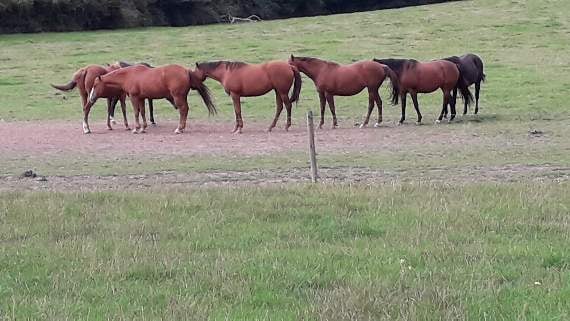
I didn’t see any on this visit, but there were horses – not racehorses, but polo ponies maybe –standing nose to tail, their tails loudly swishing across each others’ faces to keep the flies off their patiently-nodding heads.
It always amazes me how they invented such a clever way to keep the pesky flies at bay.
Turn left and climb the stile which leads you into the lane, then turn right over a ford.
This was known to us as children, and my children, as the ‘water splash,’ and happy weekend hours were filled playing there.
Many times we had to slosh home with ice-cold wet feet!
Now the ford has been concreted over and the water trickles over the concrete, cascading back down from it into the stream like the edge of an infinity pool.
Not much hope of making a dam nowadays or getting your welly boots filled with water.
On the overlooking oak trees, squirrels were jumping from branch to branch above me to cross to the stream; the ground was covered in acorns.
This lane, its banks covered with gnarled, ivy-covered roots, is so beautiful.
Turning right at the lane’s T-junction and heading up Vann Lane, the banks and verges were full of all shades of green with ferns, nettles, hogweed and cow parsley and then the odd red campion peeping through.
The lane takes you back to where the car is parked.
If you walk on up the lane a little way past where your car is parked, you will come to Goleigh Manor House which was built in 1479 and is mentioned in the Doomsday Book.
For this beautiful woodland and lane ramble that takes about an hour, park in the layby at the top of Goleigh Hill.
The postcode for the nearest location is GU34 3SB.
It is an easy walk, but with one steep descent.
Walking across the field famous for rabbits when we were young, reminded of the ferret my youngest brother Jonathan owned as a school boy.
Jonathan’s white ferret was called Ferato – he was quite a character and definitely had his own ferret agenda.
On one occasion mum was giving Jonathan and his pet a lift somewhere, with Ferato in a cage on the back seat.
About an hour into the journey and whizzing along a dual carriageway (mum was a speedy driver!) she heard a scratching noise above her head.
Mentioning it to my brother, he looked up and was alarmed to see the outline of his beloved ferret in the roof lining over her head.
Not wanting to worry mum and perhaps cause her to crash, he hoped (and possibly prayed) Ferato would wriggle back the way he had come and drop down on to the rear seat
After all, the thick lining above them was secure and there was no way out for the pet – or so he thought, he ruefully told me later.
But minutes later mum shrieked as Ferato’s head appeared – he was hanging down headfirst, his nose level with her face making eye contact with her!
Luckily she was able to pull into a layby safely and my brother recaptured Ferato.
And this time he remembered to put the cage door bolt across – an earlier oversight he never ever mentioned to mum!
While out walking I noticed plenty of blackberries, although not for much longer I’m thinking as autumn rushes in, so now is the time to get out picking!
According to folklore, passing under a bramble branch archway can cure hernias, ruptures, pimples and boils! This has also been used as a remedy for ‘downer’ cows – cows that, for whatever reason, are unable to stand.
High-fibre tasty blackberries are also healthy, full of vitamins and minerals, and it has been said they may boost brain health.
Here are two lovely blackberry recipes you might like to try.
Late-summer Eton Mess
Roughly chop all but 20 blackberries from a 400g batch. Whip 400ml of double cream so it forms soft peaks, then fold in the chopped berries, a teaspoon of bruised thyme leaves, a tablespoon of cassis, or blackcurrant cordial, and two crushed meringues.
Spoon into four glasses and top with the whole blackberries and a sprig of thyme.
Blackberry jam
Weigh out twice as many blackberries to caster sugar and place in a very large pan, add a couple of tablespoons of lemon juice to help the preserve thicken.
Bring to the boil and then let it simmer without stirring for 20 minutes, then do the fridge test. Dollop a little of the jam liquid on a cold plate and put it in the fridge for five minutes.
If it sets, then it’s ready; if not, keep cooking and testing every few minutes. While making the jam, rinse your jam jars in hot soapy water and dry in a hot oven.
When it’s ready, pour in and screw the lids on tightly.
Comments
This article has no comments yet. Be the first to leave a comment.