
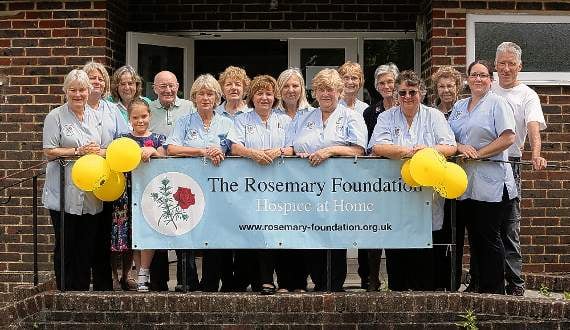
FOR THE last 20 years The Rosemary Foundation has offered support and love for those in need of end-of-life care in their own homes.
Now, the charity has reached a milestone as it marks its 20th anniversary.
The Rosemary Foundation started back in 1997 following the closure of a palliative care home run by Sue Ryder called Bordean House.
The home had provided nine palliative care beds, mostly for people who had cancer and were reaching the end of their lives. But when it was closed, it left a big hole in palliative care in and around the Petersfield area.
 VIDEO: Merry motorcade as thousands around East Hants and Sussex cheer on tractor run
 Fury in Froxfield as East Hampshire landlord tells Labour MPs: "You're barred"
 Concern at disappearance of white-tailed eagle as tracker found near Petersfield
 Roads underwater as isolated flooding reported around Herald & Post area
So, shortly after the closure in 1996, a group of Bordean nurses and some clerical staff met to discuss providing a service for people with cancer and other life limiting conditions in their own home.
The following year, on June 23, 1997, The Rosemary Foundation was born.
Jeremy Mitchell is the general manager of the ‘hospice-at-home’ organisation. He said: “They thought it would be an ideal opportunity to set up the service.
“There was no funding, just the goodwill, compassion and care of these people.
“They had four patients and they would meet every two weeks to review the patient. Sat around a kitchen table, each person put £10 in a pot and that’s how it started being funded.
“It was volunteer funded from day one.”
Due to the locations of the nurses, it was decided to set up a 15 mile radius from Petersfield in terms of the reach of the service. The nurses provided an on-call service, 24 hours a day, seven days a week.
“The overriding objective is the care and quality of service that we deliver to patients and their families and carers,” Jeremy added.
For around four years after the service began, the West Meon GP surgery commissioned the nurses to provide the community with palliative care – but the funding was cut and that’s the only time the charity has received any statutory funding.
Now, the foundation receives around 200 referrals a year and treats between 160 and 180 people each year.
The charity has now cared for well over 2,100 patients. “It’s very much about the quality of care that we deliver,” Jeremy added.
“We won’t put that into detriment. There are times when we aren’t able to get out to patients for an initial assessment as quickly as we would like to.
“But 99 per cent of the time we are able to get out to a patient within 36 hours of referral.” In 2011, the charity began to struggle financially and there were fears it would close. But, thanks to a campaign started by the Petersfield Post, money began to flood in from fundraisers and it allowed the service to keep going.
Barbara Pettegree is a regular manager at The Rosemary Foundation. She said: “We have been overwhelmed by the response and the generosity of the community. We wouldn’t have survived without it.”
Around 10 per cent of the annual funding comes from two charitable trusts which support the charity to the tune of around £35,000. But the rest of the money comes from donations.
Jeremy explained: “Statistically, something like 80 per cent of people would like to die at home. It’s for the comfort and security.
“It helps lead to a less stressful death for everyone involved. It also means that they can be surrounded by their loved ones.
“It’s the emotional support as much as anything. As we are voluntarily funded we aren’t restricted as to how long we remain with a patient or their family.
“If they want us to stay after we have provided personal care to the patient, we will quite often stay and talk through the situation.
“Our service doesn’t just stop when someone dies. We will try and get along to the funeral and we will continue to offer support to the families and carers.
“We offer a bereavement support service as well. It’s incredibly humbling working here. The generosity of the community is equally as humbling.”
Tough financial periods in the past are being consigned to the history books of this popular and vital service provided for Petersfield and East Hampshire.
Events are now being held to mark the charity’s 20th anniversary, and bring in fundraising which helps to ensure the foundation can continue to meet all of its commitments.
Many people across the area are holding tea parties using China to celebrate and to raise money – China being the traditional gift for a 20th anniversary.
Now, the charity is looking ahead to the future – and to the next 20 years.
Jeremy said:?“Initially we are going through a period of change as some of the nurses who have been with us for 20 years are moving on.
“We are very fortunate that we have recently recruited two senior nurses.
“We don’t see the ethos of the approach of the organisation changing. We won’t allow it to be compromised.
“With an ageing population, people are becoming unwell and reaching the end of their life for a combination of reasons. We are seeing a lot more people with heart failure and Motor Neurone Disease.
“We are limited by the amount of money that we can raise each year but we are optimistic going forward. There’s always going to be a need for our service and we will maintain the standards that we do and people will always appreciate what we do for them.”
Barbara added: “The nature of our work is changing because cancer is now a chronic condition. Now, we are finding that we are able to discharge people.
“A percentage of them might have chemotherapy or radiotherapy and they are given an extension of life.
“There’s been improved medical treatment. Most people are cautious and say that we haven’t got a cure for cancer. But for people who have got cancer, that gives them hope.
“While there’s a hole that needs to be filled, we will fill it. If the health service produced first class, end of life care we wouldn’t be needed and that would be something to celebrate.
“But while there is this gaping hole, we will do our very best to fill it.”