
This walk can best be described as a balloon on a string, being both circular and part-linear.
While not a particularly strenuous walk, there is a 359ft (109 metre) climb involved and it has many points of interest along the way.
Ten keen walkers arrived at the spacious Boxgrove Village Hall car park that is but a stone’s throw from the start of the Windmill Trail which is very clearly marked.
The weather was surprisingly sunny, given the forecast, but there was a brisk and strong northerly wind which caused deliberation about how many layers to start off wearing. Decisions made and enacted upon, we set forth.


We could immediately see the windmill in the distance to our left as we walked around the edge of fields, newly sown with crops.
The going was good and quite dry despite looking as though it had not long ago been very muddy and churned up by the passing of tractors going about their business.
The trail then passed between two attractive rows of trees, beside leafless vines, waiting for bud burst and for the season to progress.
These vines are part of the Tinwood Estate, their first planting being in 2007.
Since then, they have established a reputation for producing fine sparkling wine.
It is possible to arrange to tour the vineyard, learn about wine making and taste their range of sparkling wines.
We crossed the busy A285 and made our way along Mill Lane and through the famous archway of trees that was once part of the 57-mile Roman road that ran between London and Chichester.
Fortunately, the shrubs, bushes and trees that formed the archway were now in leaf so we had the full effect of a tunnel.
The windmill was, unsurprisingly, approached by walking up a hill, a gradual climb and very easy.
The surrounding fields were sporting rape seed and in full dazzling colour.
It was well worth the climb up the hill to admire the iconic Sussex landmark close up.
It is possible to walk all around it and there is a bench to rest and admire the 360-degree views.
The wind was blowing so strongly, however, that we sought the shelter of the Second World War radio direction-finding structure nearby to have a banana break.
This structure and its radio direction finder had been used during the war to monitor the comings and goings of aircraft.
The remains are one of four separate radio direction finding stations about 100 metres apart in a semi-circular arc on the east side of Halnaker Hill built to track, identify and direct our own fighter aircraft.
It was probably no coincidence that the wartime airfield RAF Tangmere is only a few miles from Halnaker Hill and its structures.
Halnaker Hill and the wartime structure are part of a Scheduled Ancient Monument and the windmill is Grade 2 listed.
We were disappointed to see the sails had been removed from the windmill, but hopefully they will be returned once assessed and repaired if necessary.
Returning by the same route, (the balloon string) we could admire the tunnel of trees again.
Diverting left, we took the lane that passes vineyard buildings to the right and to the left, the disused Boxgrove Quarry that is now inaccessible woodland and carpeted with bluebells.
This is an important palaeolithic site where a 500,000-year-old part of a human leg was found, currently the oldest human (hominin) remains in the British Isles and known locally as Boxgrove Man.
The path bordered more bare grape vines and led us to a field across which there were views of Boxgrove Priory and the Church of St Blaise.
With the walk almost over, we took a brief but worthwhile visit to the church and the priory.
The church is surprisingly large and dates from about 1120 and is now the parish church.
The priory was founded in 1105 when three monks were sent from Normandy to administer the changes of the existing Saxon Church.
It was dissolved in 1537, but the church’s development continued and the ceiling was painted at the behest of Thomas de la Warr, Lord of the Manor.
The ceiling is still a sight to behold and visitors are welcomed.
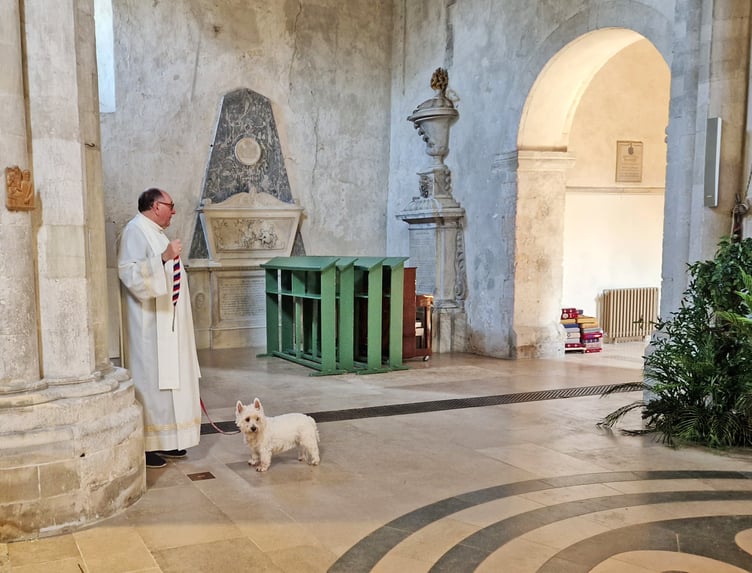
We were unexpectedly treated to a clergyman accompanied by a dear little dog who patiently waited while his master chimed the church bell ahead of a prayer.
And a church existed here before the Norman Conquest, the Domesday Book reveals.
Our final stretch took us through the village, past historic alms houses and then back to the car park, to end a very interesting morning’s walk.
n For details about Petersfield Ramblers visit the website at www.petersfieldramblers.org
Linda Farley
Petersfield Ramblers membership secretary
Photos:
Paul and Linda Farley.
Comments
This article has no comments yet. Be the first to leave a comment.