
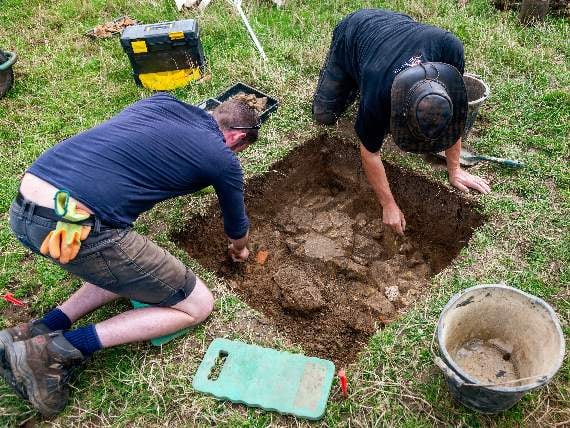
LISS Archaeology members new and old took part in a nine-day big dig at Stroud.
As well as excavation, geophysical surveys using resistivity and magnetometry were carried out in several fields.
New members from Haslemere, Midhurst, Winchester, Bournemouth and Alton took part in the big dig.
In total, five test pits were opened. One, placed over a small, round hollow on the field, appeared to just be a natural dip in the ground, but the other four test pits were fruitful.




There was a mound created from Romano-British (RB) building materials, a seemingly straight-edged, deliberately laid structure crafted from hard, flat stone and RB ceramic building material (CBM), a pile of placed CBM floor tiles with notches cut from an edge and a laid surface created from flat blocks on stone.
Pottery unearthed dated the features to RB times.
Geophysics was carried out in several places. The survey was looking for the water source for the known Roman villa in a nearby field, and the results showed a linear feature running across the field in the right direction and a curving area.
These could be to do with a water system as streams were diverted, but Liss Archaeology members will return next year to investigate this further.
Liss Archaeology members also took part in a day of geophysics in Alton Town Gardens.
The next event for Liss Archaeology is more than three weeks of excavation at Colemore. The excavations started yesterday (Thursday) and will finish on October 15.
New members are also welcome at Liss Archaeology. Anyone who would like to become a member or attend the Colemore excavation should visit the website at: www.lissarchaeology.uk