
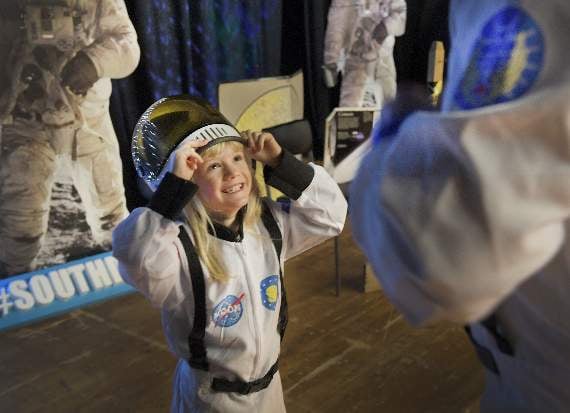
STARGAZERS can enjoy cosmic fun for all the family when the fourth annual Dark Skies Festival visits Petersfield later this month.
The event is organised by the South Downs National Park Authority to take advantage of the lack of light pollution in the sky above the park.
Petersfield’s Festival Hall will stage the free Stargazing South Downs roadshow on February 18 from 4–8pm.
There will be indoor planetarium shows, a virtual reality experience exploring the Milky Way, nocturnal wildlife displays, talks by Dark Skies experts, a colouring wall of the solar system, science experiments and an astronaut selfie booth.
 VIDEO: Merry motorcade as thousands around East Hants and Sussex cheer on tractor run
 Fury in Froxfield as East Hampshire landlord tells Labour MPs: "You're barred"
 Concern at disappearance of white-tailed eagle as tracker found near Petersfield
 Roads underwater as isolated flooding reported around Herald & Post area
If the night sky is clear there will also be moongazing and stargazing outside for people to see the universe in all its glory through large telescopes.
The roadshow will include guidance on how to make the most of a telescope, and a quiz with a telescope prize for the winner.
The Dark Skies Festival from February 7–23 will feature events held across the national park to celebrate its International Dark Sky Reserve status.
This was awarded in 2016 and recognises the park as one of the 16 best places in the world to view the moon and stars.
There will also be a Stargazing South Downs roadshow at Midhurst Rother College on February 8 from 4–8pm.
Gilbert White’s Field Studies Centre in Selborne will host From Fire to Ice - A Journey Through the Solar System on February 12.
Visitors will discover how extreme temperatures fashioned unique worlds in the solar system, and learn about what telescopes and planetary probes have found.
Dark Skies ranger Dan Oakley said: “Seeing the immense views of the starry sky over the national park is an incredible experience.
“Aside from being unbelievably beautiful and awe-inspiring for us to look at, the dark star-studded skies are vital for all flora and fauna.
“Life on Earth evolved with bright days and dark nights, so nocturnal species such as owls, bats and moths rely on this natural shift that repeats every 24 hours.
“More than 60 per cent of invertebrates and 30 per cent of vertebrates are purely nocturnal, while many of the other species are crepuscular – active at dawn and dusk – so you can see how crucial dark skies are for biodiversity and the health of the environment.”
The complete events schedule is at www.southdowns.gov.uk