
People wanting to learn about the history of Hawkley should visit Hawkley Village Hall on November 2 from 10am until 4pm.
It will be hosting the latest of Petersfield Museum’s Museum Roadshows, and visitors are encouraged to take with them objects, records and photos relating to Hawkley in times gone by.
The museum has been holding roadshows in the villages around Petersfield over the last five months.
They raise awareness of its collections and the stories they tell, show off the history of the host village and offer residents a chance to find out more about it or share their stories with the museum.


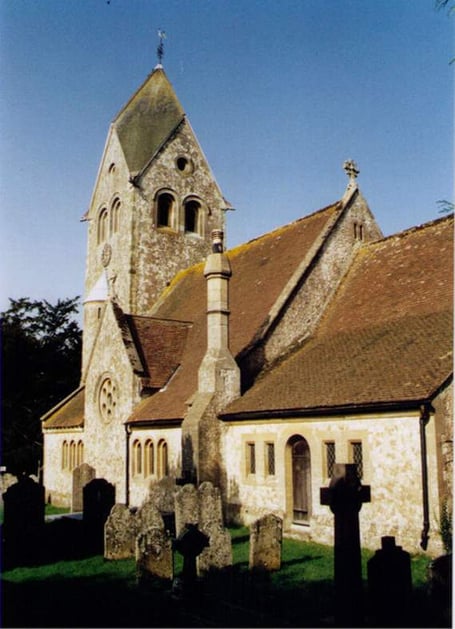
Hawkley’s church includes a rare example of a Rhenish Helm, a spire type more commonly found in mainland Europe.
The current church of St Peter and St Paul dates from 1865, although there was a church in the village dating from the 12th century whose Purbeck font can still be found in the later church.
The 1865 church was designed by the architect Samuel Sanders Teulon. His early work was generally in Tudor or Elizabethan style but he later became a supporter of the Gothic revival, which can be seen in his design of St Peter and St Paul’s.
Teulon was well noted for his elaborate designs, with his work at Elvetham Park in Hampshire described as so complex in its composition and so varied in its detailing that it quite defies description. That was a world away from his restrained design in Hawkley.
The most notable element of the church’s design is its Rhenish Helm, a spire typical of the Romanesque church architecture of the historic Rhineland.
It is a pyramidal roof on towers of square plan. Each of the four sides of the roof is rhomboid in form, with the long diagonal running from the apex of the roof to one of the corners of the supporting tower.
Each side of the tower is topped with an even triangular gable, from the peak of which runs a ridge to the apex of the roof. Why this design was chosen is unknown.
The belfry contains a full peel of eight bells. Three of them are from the 12th century church, with two dating from about 1450 and the other from 1624.
After the church was rebuilt, Rebecca Maberly presented two bells in 1867. Another was added in 1900 in memory of churchwarden George Wakeford, and the last two were given by Mr and Mrs Clive Davies in memory of their son Harold, who was killed while serving in the Royal Navy during the Second World War.
The tenor bell, weighing 949lb, was recast in 1997 in memory of former tower captain Charles Pound, replacing the one given by Rebecca Maberly.
In the south chancel wall was a finely carved alabaster panel depicting Christ’s betrayal by Judas which was stolen in the 1980s but replaced by a carved wooden replica.
The 19th century organ made by London firm Bevington originally had a mechanical or tracker action. Ivemey and Cooper rebuilt it in 1939 with a pneumatic action, and in 1999 Henry Willis and Sons rebuilt it again to include an electric action and a second manual.