
IT’S MORE than 4,000 miles (6,800km) between Petersfield and the city of Jaipur in northern India but an artefact in Hampshire, which may be 400 years old, is a puzzling link between two dramatically contrasting areas of the world.
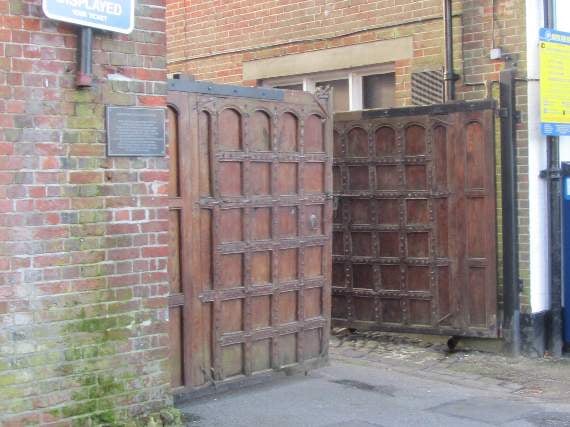
Most people who visit the Red Lion in College Street – the former London-Portsmouth road through the centre of Petersfield – will have paid no heed to the heavy wooden gates giving access to the courtyard and former Masonic Hall at the back of the pub but the gates are no ordinary security feature.
According to a metal lettered plate at the side of the gates they are a pair of elephant doors and originated from the hill forts of Rajasthan.
The six Hill Forts of Rajasthan, spread across Rajasthan state in northern India, are clustered together as a designated United Nations World Heritage Site. The forts are mainly based in the Aravalli Range and were built and enhanced between the fifth and 17th to18th centuries by several Rajput kings of different kingdoms.

There is no indication on the plate at the Red Lion about how the ornate teak doors could have arrived in a small market town in England so far from where they were made and first used.
The most prominent former Petersfield resident with a connection to the Indian sub-continent was Richard Churcher, who made his fortune from investing in the East India Company in the 1700s but Gill Clarke, who is archivist of Churcher’s College, the school founded from his bequest, said he never went to India so was unlikely to have brought home the gates.
But Colonel Henry Bethina Hanna, who was 75 when he died at his home, Heathmere in The Avenue, Petersfield, in 1914 is a potential candidate as the man who left a touch of Indian splendour to his home town when he died.
According to local historian David Jeffery in his book Petersfield A Hundred Years Ago, the future colonel was brought up in one of the cottages at the top of Ramshill – he could remember the old days of stage coaches as they arrived at and departed from the town.
His life revolved around the Army. He spent 32 years of it in India at the time of the mutiny in 1857, married there and returned home with his English wife in 1889. When he retired, he became a writer on military history, particularly the Afghan Wars in which he had fought.
As mentioned in previous Nostalgia articles in the Post, Colonel Hanna was a strong supporter of community life in the town, including the football club of which he was president and where he donated the Hanna Cup, which has symbols relating to India as decoration.
He gave £250 towards building the Working Men’s Institute – now Petersfield Social Club – he was a governor of the cottage hospital, supported the Workers’ Educational Association (WEA), the town’s literary and debating society and was a staunch Liberal and backer of women’s suffrage.