
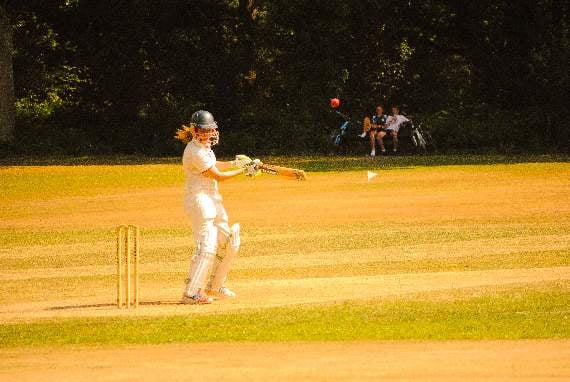
THREE thousand people attending a village cricket match and a ladies match at that? Impossible to imagine today, but it did happen 250 years ago – in Rogate.
During research into the archaeology and history of Fyning Recreation Ground in Rogate parish, a group of Southdowns Heritage Volunteers came across the following contemporary report from the Reading Mercury, quoted by Tim McCann in his book Sussex Cricket in the Eighteenth Century (2004).
“A series of matches took place in 1768 between 11 young women of Rogate and 11 young women of Harting which were played at Harting on 2nd and 27th June 1768. On Saturday 18th June 1768 a match was played at Rogate Common, which Rogate won by two notches. There were 2,000 spectators at the event.
“Another game was played on Wednesday 22nd June 1768 at Rogate Common. This time there were said to be 3,000 spectators. These are extremely high figures for spectators at an 18th century cricket match. Matches between women were relatively common at the time.”




Rogate Common, which today is mainly commercial woodland west of Broad Road, north of Slade Lane and below Top Road, was, until the 1861 Rogate Inclosure, part of ‘the Parish wastelands’, that is common heathland where all parishioners had the right to graze a given number of animals and to gather turf, wood, heather and bracken for domestic use.
According to Isabelle Duncan in Skirting the Boundary: A History of Women’s Cricket (2013), with the blossoming of village cricket in the 18th century many villages staged regular women’s cricket matches.
She writes: “Curiously, these games would often be described as ‘Married v Single’ or ‘Married v Maiden’ and were followed by spirited social gatherings.
“They were also accompanied by enthusiastic gambling and the victorious teams were awarded splendid prizes. One winning team took home 11 pairs of gloves and pieces of lace, and another was awarded 11 hats. Even the umpire did not go home empty-handed.”
The full flavour of the social merriment had by all at 18th century ladies cricket matches is captured evocatively by the contemporary report of a typical village game in 1765 at Upham near Winchester: “A few days since, a cricket match was played by 11 married against 11 maiden women for a large plum cake, a barrel of ale and a regale of tea, which was won with difficulty by the latter.
“After the diversion the company met and drank tea; they spent the evening together and concluded it with a ball.”
Many 18th century aristocrats realised that cricket was not only great sport but also an excellent opportunity for betting. Although no evidence has yet emerged for the Rogate v Harting matches, the presence of several thousand people drawn to Rogate Common suggests the likelihood of sky-high stakes being wagered by aristocrats and businessmen.