
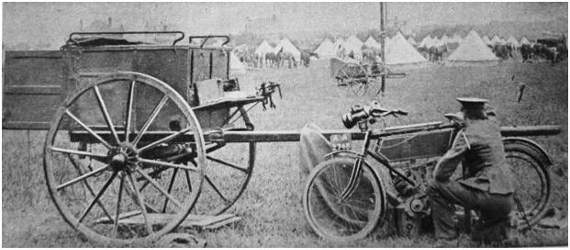
AS WE approach 100 years since the end of the First World War, a project looking into the role of the military motorcycle is looking for volunteers to provide an insight into this often-forgotten mode of military transport.
Hampshire author and project lead Martin Gegg said while many people are familiar with First World War despatch riders, the path of the motorcycle to the frontline, and even the development of the despatch rider is not so well known.
Following the Boer War, in the early 1900s the War Office was concentrating on mechanising the military, including logistical support for the cavalry.
Manufacturers suggested various motorcycles, but without a role they were rejected. While it is easy to assume as some did at the time, that the motorcycle was a threat to the cavalry, the reality was that they were just not suitable to replace troops mounted on bicycles let alone horses.

As motorcycles developed further from being merely bicycles with engines, they began to be seen at annual manoeuvres as unofficial participants, where volunteer riders would act as scouts and carry messages to and from the front.
Still the War Office was unconvinced, but agreed a committee should consider their use.
As supporters of military motorcycles became more frustrated and formed their own group of volunteers, the War Office started tentatively to experiment with motorcycles for convoy escort resulting in volunteer riders being employed as convoy escorts, scouts and despatch riders at manoeuvres which covered vast areas of the south and west, including Rowlands Castle where members of the Royal Engineers’ wireless section were camped.
Following these successful tests, the Army Service Corps opted for the little Douglas 2¾ H.P. machine as it was ideal for managing convoys.
By 1913, the newly-formed Royal Flying Corps, quickly saw a requirement for despatch riders using Phelon and Moore machines to transport photographic plates to and from airfields, while the Royal Engineers was keen to use motorcyclists with fast Triumphs for laying and repairing telegraph cables as well as transporting classified papers.
In 1914, with a defined place in the military plan, the War Office was now short of the volunteers and motorcycles required if war broke out.
Consequently, readers of motorcycle magazines were urged to sign up with their own motorcycles as war was declared. Within days, manufacturers had supplied the military with 11,638 machines. By the end of the war there were 34,865 motorcycles in use with countless others destroyed during the conflict.
It is suggested that Triumph alone supplied 30,000 machines and the humble motorcycle went on to be represented in every conflict since.