
AFTER moving around in various premises in High Street, Petersfield, the town’s library settled in Winton House in 1948.
This building, at 18 High Street and its neighbour at 20, now The Rowans Hospice shop, has a long and distinguished history, having been the site of the White Hart Inn, the town’s most important hostelry in the 17th and early 18th centuries.
Today’s Folly Lane was a carriageway between the two parts of the inn, leading to stables, coach house and ostlers’ quarters. It also gave access to a bowling green attached to the inn where diarist Samuel Pepys is believed to have played.
It operated as an inn for more than 200 years then, when John Cross of Horndean, became the occupier in 1808, he transferred the licence to a new building in the grounds, facing towards the turnpike road, later College Street, where the new White Hart served drinkers until its closure in 2010 and replacement with a group of new homes.

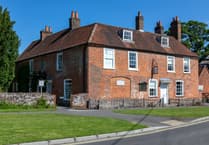


Meanwhile, the larger building of the former inn had been converted into a private house and the western one continued as the Post Office.
Through much of the Victorian era, the premises were used by the Pesketts, father and son, who were doctors, then they were succeeded by Dr Albert Leachman in 1871. Another doctor, WP Panckridge, was a much-respected figure in Petersfield but when he retired in 1921, Winton House came on to the market and, after the next 27 years being used by the community, principally women’s organisations, the library gradually took over the whole of the ground floor.
Still there was never enough space and, with the continuing development of Hampshire’s county library service, the search began for a suitable site for a purpose-built library to be constructed in Petersfield.
The year 1964 began a period of development, much of which was perceived as the destruction of the character and history of the town, by a particular developer, Raglan Property Trust, which had begun buying old buildings, such as the Dolphin Hotel in High Street, and demolishing a number of them.
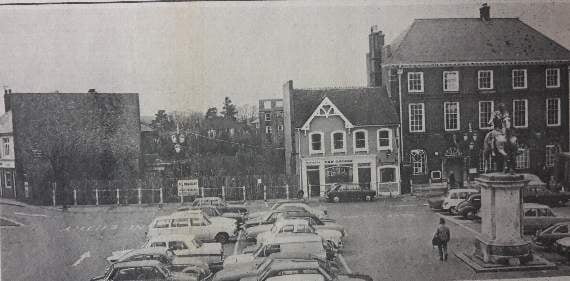
One of the sites it acquired was next to The George Inn on the west side of The Square where two private houses had been converted in the early 19th century from part of the inn’s premises. Later, businesses occupied these, including the Temperance Coffee Tavern, Barrett’s photographic studio, Southdown bus office, a card shop and, on the corner of Sheep Street for many years, George Money’s second-hand furniture and hardware shop.
Raglan demolished those buildings in 1971 but it was another ten years before the library was completed and staff then transferred 14,000 books from Winton House to the new shelves where they joined a further 19,000 books.
Employees from 1981, including Youth Opportunities trainee Rebecca Geer, can remember making hundreds of trips along High Street carrying precious volumes.
She said: “It was a very enjoyable place to work with some lovely people.”