
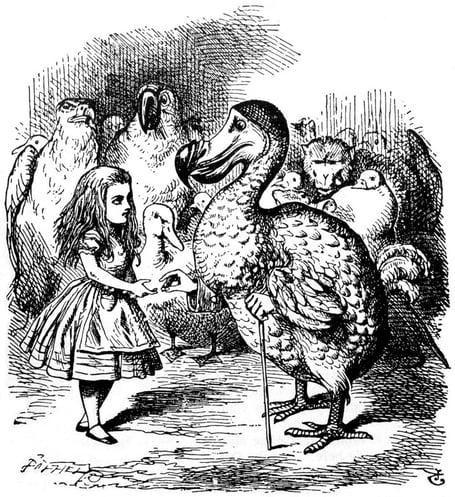
Charles Lutwidge Dodgson left behind a legacy that reached far beyond the lecture halls of Oxford and the pages of Victorian children’s books. He also left traces much closer to home — including in Haslemere.
Dodgson was born in Daresbury, Cheshire, in January 1832. He died at Chestnuts, his sisters’ home near Guildford Castle, and was buried at Mount Cemetery in January 1897. His funeral took place at St Mary’s Church, Guildford, where he sometimes preached, and was conducted by Francis Paget, Dean of Christ Church, Oxford, reflecting his long career there as a mathematics lecturer.
The name Dodgson may not be immediately familiar to many readers, but his pen name is known worldwide. Writing as Lewis Carroll, he was the author of Alice’s Adventures in Wonderland (1865) and Through the Looking Glass (1871). Less widely known are his intriguing connections with Haslemere, beyond the fact that Alice in Wonderland was the first pantomime staged at Haslemere Hall.
An article in The Daily News of September 2, 1904 quoted Lewis Carroll in relation to the first exhibition of handicrafts organised by the United Haslemere Industries. On display were works by the Peasant Artists of Foundry Meadow, alongside an altar frontal destined for Buckingham Palace, created by the St Edmundsbury Weavers of College Hill. The journalist wrote that Haslemere’s crafts “preserved the aesthetic side of manufacture and the dignity of the human hand”, standing in opposition to modern industrial production and what Lewis Carroll himself would have described as “uglification”.


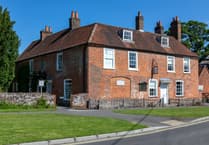

For those unfamiliar with the term, the Gryphon explained it to Alice in Through the Looking Glass: if you know what it means to beautify, you must be a simpleton if you do not know what it means to uglify.
So what were the local industries that so impressed a Victorian journalist?
A short walk along Kings Road from the railway station leads to two striking black-and-white buildings opposite Foundry Lane. Built in the 1890s, they served as weaving and tapestry studios for the Peasant Artists, founded by Joseph and Maude King, together with Maude’s sister and brother-in-law, Ethel and Godfrey Blount. The Peasant Artists embraced a simple, rural life, rejecting industrial processes in favour of crafting hand-woven and appliqué objects using natural fibres.
In 1902, Edmund Hunter established the St Edmundsbury Weavers on College Hill, producing luxurious hand-loomed silks. The business soon outgrew its premises and relocated to Letchworth in 1908.
The 1904 exhibition article records that an altar frontal for Buckingham Palace was purchased by Queen Alexandra, wife of Edward VII — not her first acquisition from Haslemere. Another report notes that earlier that year she visited a Home Arts and Industries exhibition at the Albert Hall, buying a white-and-gold altar frontal by the St Edmundsbury Weavers and a yellow-and-green rug from the Peasant Artists.
It is through the Peasant Artists that a direct personal link with Dodgson can be traced. Their associate, and Joseph King’s cousin, Greville Macdonald, a London ear, nose and throat surgeon, later moved to Wildwood on Weydown Road, next door to Godfrey and Ethel Blount at St Cross. In his memoirs, Reminiscences of a Specialist, Greville recalled his “Uncle Dodgson” as a regular visitor.
Dodgson and Greville’s father, the celebrated fairy-tale writer George Macdonald, became friends after being introduced by a doctor attempting to cure Dodgson’s stammer. Greville later remembered his mother, Louisa, reading the first Alice book aloud to her children at Dodgson’s request, “just to see how we took it and thus to gauge its worth if published”. The verdict, fortunately, was favourable.
There is also an artistic connection through Godfrey Blount. Christ Church College, Oxford, where the shy and retiring Dodgson taught mathematics, holds Dodgson’s posthumous oil portrait (1899) by Royal Academician Hubert von Herkomer, at whose art school in Bushey Godfrey Blount trained.
These interwoven threads of history, from the Peasant Artists’ workshops and Queen Alexandra’s patronage to the visits of “Uncle Dodgson”, show that Haslemere was more than a quiet market town. For a time, it was a place where skill, imagination and creativity converged, leaving a legacy that continues to shape the town today.
Comments
This article has no comments yet. Be the first to leave a comment.