
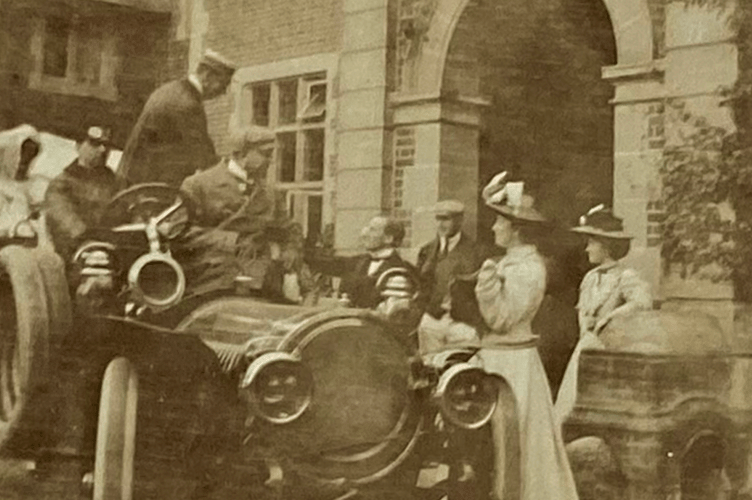
Last year, during the 100th anniversary of Frensham Heights School, a remarkable book of photographs was found in a skip outside Tanyard House, writes Roy Waight.
When opened, the reader was transported into a magical past world of Edwardian grace, cricket, fashion and fun. The album contains hundreds of photographs dating from between 1907 and 1909, taken mostly at Frensham Hill, built by the brewer C E N Charrington around 1900. This great house subsequently became the home of Frensham Heights.
The first page consists of the initials HWA in attractive lettering. The whole of the album is interwoven with twisting ribbons in a William Morris style. Interspersed here and there are little cameos that look very ‘Beatrix Potter’. The album was put together and garlanded by a talented artist.
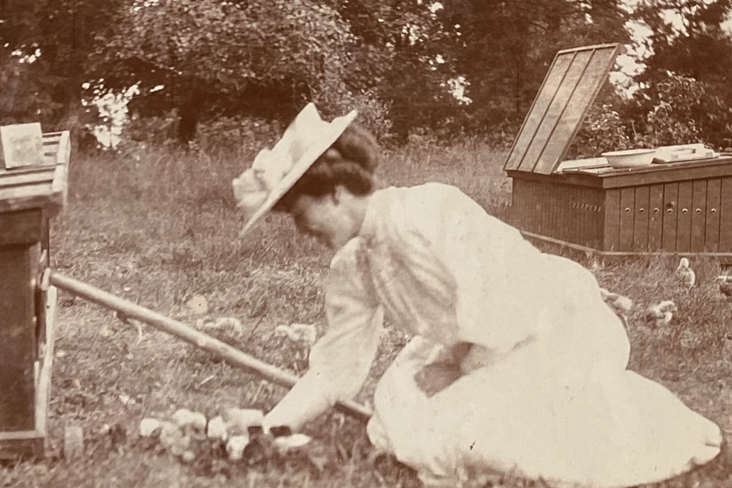



Local historian Neil Pittaway soon deduced that HWA was a certain Henry Whiston Atchison. He was born on April 30, 1881, and died on February 10, 1962. His father, Colonel Charles Henry Atchison, is mentioned in Burke’s Peerage. HWA was a keen cricketer and must have been good, since he played for the Free Foresters before the war.
The link between Henry Whiston Atchison and C E N Charrington probably originated in their mutual love of cricket. Presumably, they became friends after the Free Foresters played at Charrington’s cricket ground, reputedly of first-class standard.
Many of the photographs in the album show cricket teams who played at Frensham Hill. Charrington was certainly a keen cricketer and, when he built Frensham Hill, he made sure he had provision for the great game. Many of the teams that visited were good, such as the Old Carthusians, the Hampshire Hogs and the Free Foresters themselves.
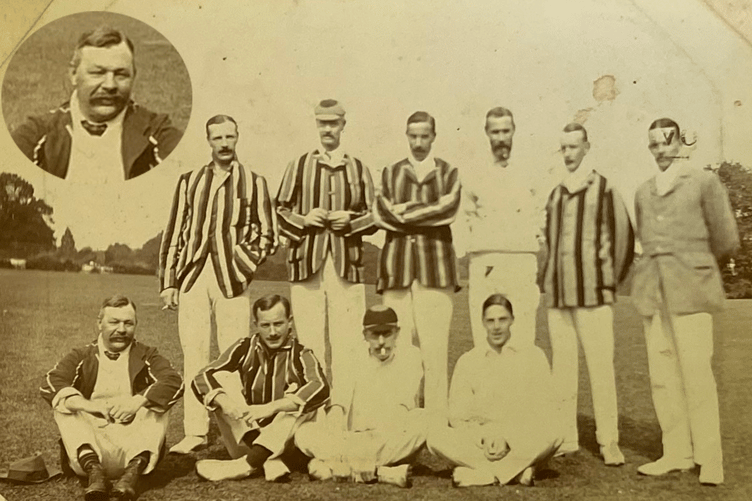
Dr W G Grace had played at Frensham Hill and, although there is no photograph of the illustrious doctor in the album, there is a photograph of Ranjitsinhji, one of the great cricketers of history.
And, looking out from one of the photographs, is none other than Sherlock Holmes author Sir Arthur Conan Doyle.
As well as his literary reputation, Conan Doyle was also a fine cricketer, who once bowled out W G Grace when playing for the MCC (”my proudest moment”, according to Conan Doyle).
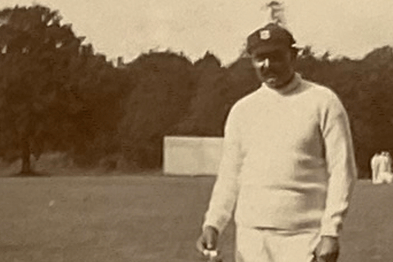
There is also a fine photograph of Bernard Bosanquet, who has earned a place among the immortals of cricket as the man who invented the googly. You can see him showing the Frensham Hill-ites how to perform this magic delivery. Apparently, in one game the men played the ladies. The men had to use cricket stumps instead of bats. The men still won.
Other photographs reveal, with a faded poignancy, the sheer majesty of the building as it was in 1907, the superb gardens, the wonderful cricket pavilion, and the various lawns and coigns, which begin to make plausible reports that Frensham Hill cost Charrington £250,000 to build.
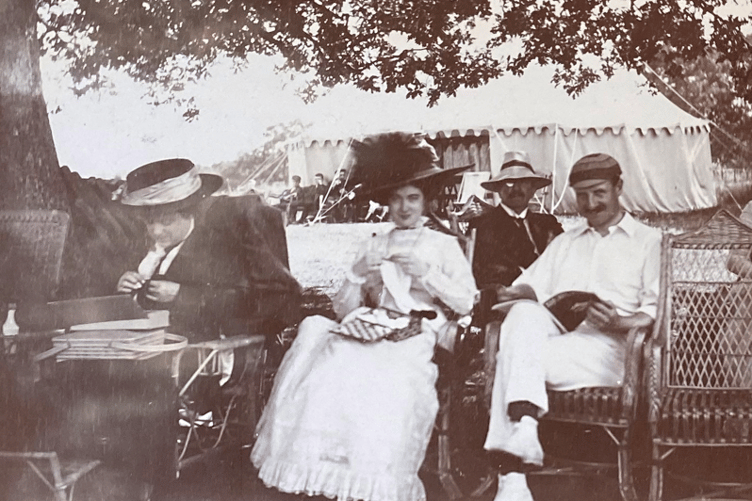
Then there are hosts of elegant ladies, all dressed in long dresses and elegant hats, and the men, mostly looking as if they had walked off a set from a P G Wodehouse film. There is plenty of chiffon and a surfeit of tailored blazers. Then there is Charrington’s magnificent motor car, the numerous liveried servants, the horse riding and numerous party games (there is a lovely photograph of the ladies engaging in a decorous tug of war). Picnics, tea on the lawn, relaxing on a swing like a painting by Fragonard … even someone apparently with a falcon.
But what comes across most markedly is the impression of Edwardian grace and carefree living. Someone described the Edwardian era as a “leisurely time when women wore picture hats and did not vote, when the rich were not ashamed to live conspicuously, and the sun really never set on the British flag”.
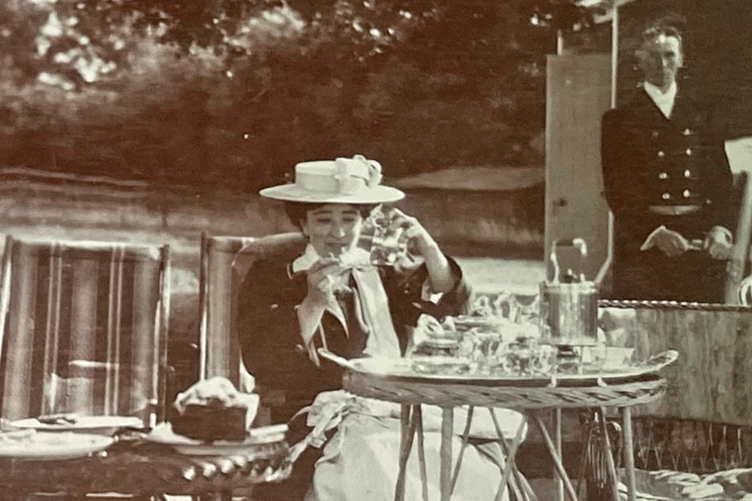
The Edwardian age was, perhaps, the last one where the vast difference between the wealthy and the poor was manifested by the former without embarrassment. In this fantastic photograph album we see wealthy and privileged people living out the comic opera of pre-war existence.
Roy Waight is chairman of the Farnham and District Museum Society. Anyone interested in joining the Society can do so via its website: www.farnhammuseumsociety.org.uk
Comments
This article has no comments yet. Be the first to leave a comment.