
Although most often associated with fine art, the term “masterpiece” can rightly be applied to part of Farnham Castle – one which, despite its excellence, is strangely hidden from view, writes Derek Carpenter.
This “masterpiece” was created by a 14th-century contemporary of Geoffrey Chaucer, master carpenter Hugh Herland.
Chaucer famously ridiculed a carpenter in The Miller’s Tale as old, foolish and easily duped. The craftsman responsible for Farnham’s masterpiece was the very opposite. Herland was a highly skilled master carpenter, favoured by the Bishop of Winchester and by royalty.
He undertook many demanding commissions, from harbour quays to finely carved tomb canopies and wooden vaulted ceilings, and served as both a civil and military engineer.

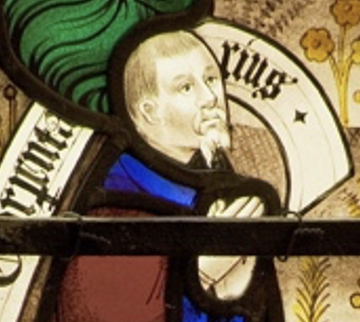
Herland’s hidden masterpiece at Farnham Castle is an oak “scissor-brace” roof, built around 1380. The roof is undoubtedly a masterpiece: a mighty and complex structure created from timber sourced from local oak forests, such as Alice Holt, which surrounded much of Farnham at the time.
Nearly 650 years on, it still performs its role, supporting the weight of the large tiled roof above what is known as the Bishop’s Camera – the bishop’s private accommodation within the palace.
Born around 1330, Hugh Herland learned his trade alongside his father William, an already skilled and royally supported carpenter. Hugh worked with his father not only on carpentry projects, but also on work requiring architectural knowledge and broader building expertise. In the 1360s, working together, they carried out commissions for King Edward III at the Royal Palace of Westminster and the Tower of London.
It was Herland’s association with the Bishop of Winchester, William Wykeham – founder of Winchester College and New College, Oxford – that helped accelerate his reputation. Soon after Richard II ascended the throne in 1377, Herland was appointed the King’s carpenter, a position he held until 1400.
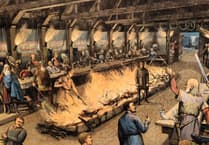
Three years into his royal role, Bishop Wykeham commissioned Herland to build the roof above his Camera at Farnham Palace. The timbers were sourced from locally forested oak trees, and a sawpit built just outside the castle walls was used to cut the felled trees to size.
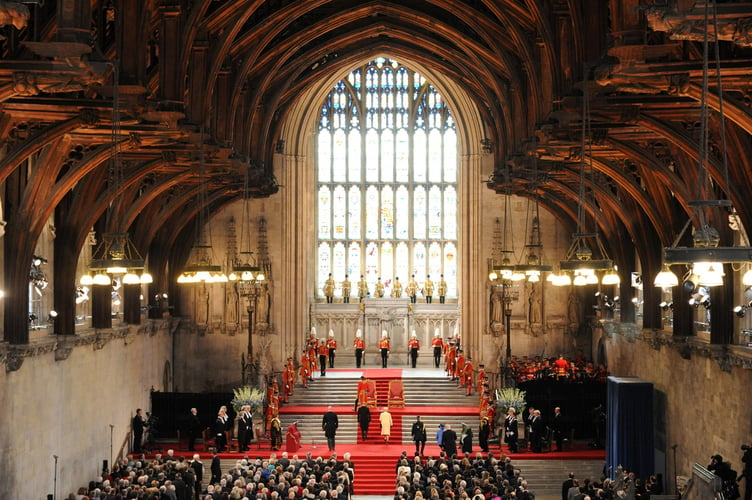
The experience gained in Farnham is thought to have contributed to Herland being awarded his most prestigious and best-known royal commission in 1390: the construction of a new roof over Westminster’s 11th-century hall.
Working with stonemason Henry Yevele, who provided new supporting stone buttresses, Herland designed a “hammerbeam” roof capable of spanning the hall’s full 68-feet width. The design required no mid-span supporting columns, allowing an uninterrupted view along the hall’s 240-feet length. It was one of the greatest architectural innovations of its time.
A major advantage of Herland’s recent work in Farnham was that the skilled workforce and production facilities established to build Bishop Wykeham’s roof were still in place at the castle. Although the vast quantity of oak required exceeded what could be supplied solely from forests around Farnham and Odiham, it was considered more cost-effective and practical to transport timber from as far away as Kingston to Farnham, where construction facilities already existed.
As a result, the Westminster roof was cut and fashioned at Farnham Castle. The numerous timbers for each span were assembled, joints tested, and components uniquely labelled and numbered so they could be transported and reassembled on site.
The number of horse-drawn wagons needed to carry many hundreds of tons of beams to the Thames at Ham, and the barges required to ship them upriver to Westminster, is unknown, but it was a huge logistical undertaking, all carried out to meet King Richard’s demanding deadline.
In Farnham, the siting of a plaque commemorating Herland’s work places the construction of the Westminster roof near the present Lower Hart and Waitrose car park. Although this location is most likely inaccurate, the plaque rightly recognises both Herland’s and Farnham’s major role in a project of national importance.
Westminster Hall has since witnessed the trial of Charles I, the aftermath of the Gunpowder Plot, royal banquets, the lying in state of monarchs from Edward VII to Elizabeth II, and addresses to Parliament by world leaders including Nelson Mandela, Barack Obama and Volodymyr Zelenskyy.
Derek Carpenter is chairman of the Farnham Castle Society.
Comments
This article has no comments yet. Be the first to leave a comment.