
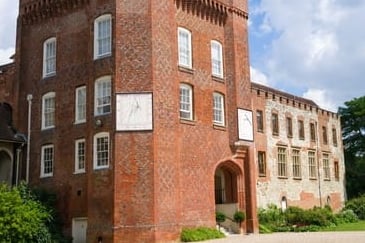
On an autumn afternoon in October 1940, a ‘curious collection’ of about 30 men disembarked from the London train at Farnham station, writes Gillian David.
This group contained the first, and perhaps the most illustrious, students of British military camouflage, heading for Farnham Castle, where the Camouflage Development and Training Centre had been recently established.
The group was not expecting to be housed in the splendid surroundings of Farnham Castle, but to be billeted in accommodation more akin to barracks than a medieval castle.
One of the new arrivals, the surrealist painter and printmaker Julian Trevelyan, recalled his first impressions: “What was my surprise then, to be driven up to a venerable Tudor Castle, amongst cedar trees, and to be greeted by a charming young adjutant who apologised profusely for the shortcomings of the staff and the incompleteness of the furniture … where were my endless rows of sleeping soldiers, and the harsh camp routine that I had come to expect?

“Certainly, all my conceptions about Army life would have to be quickly revised.”
However, the comfort of the camouflage team had not been the priority when choosing Farnham Castle as the location for the training school.
More important were the opportunities it provided, the old stable block was the perfect space for a workshop, the extensive grounds permitted the placement of camouflage objects, Farnborough Airfield allowed vital access to assessing experiments from the air, and Farnham’s proximity to the military base at Aldershot Garrison was a further advantage.
Director of operations at the camouflage camp was Colonel Frederick Beddington, who possessed an unusual combination of skills, being an expert sniper and having a knowledge of art.
His brother, Jack Beddington, head of the Ministry of Information Films Division during the war, helped recruit the 30 candidates who formed this first group at Farnham Castle in 1940.
It is hard to imagine now what it must have been like at the castle between 1940 and 1944. Polished boots clattered up Bishop Morley’s grand oak staircase, drill took place on the cobbled courtyard and men in khaki milled about the medieval Great Hall between lectures.
The camouflage team was housed in the west wing, while Bishop John MacMillan resided in the eastern wing. Trevelyan was moved by his surroundings, describing “days of pearly autumn mornings, particularly beautiful in the wooded precincts of Farnham Castle”.
The students would have been greeted by the distinguished Cambridge zoologist Hugh Cott, also an artist and expert on camouflage in nature, and the only scientist in the group. Among the remarkable concentration of talent was the magician Jasper Maskelyne, who applied his skills to camouflaging tanks and lorries and, according to Trevelyan, entertained troops with conjuring tricks.
In the evenings, members of this select group enjoyed a pint or two at The Nelson Arms on Castle Street, where they mingled with students from Farnham Art College and attended productions at Farnham’s Castle Theatre.
Farnham Art College graduate Pauline Baynes worked at the castle as an assistant model-maker before moving to the Admiralty to draw maps and naval charts. She later became known for illustrating works by J. R. R. Tolkien and C. S. Lewis.
Other notable individuals among the original group of 30 included the surrealist painter, historian and poet Roland Penrose, who was married to the American photographer Lee Miller, portrayed by Kate Winslet in the 2023 biographical war drama Lee. Penrose used his artistic skills to teach camouflage.
Farnham Castle played a significant part in World War Two leading up to VE Day in 1945. Products developed there included the dummy tank, used to great effect during the North African campaign, machine gun covers, matting to hide newly excavated spoil and overhead covers for vehicles. Eventually, more than 100 people were operating from the castle in the camouflage department.
The Bishop’s Palace at Farnham Castle is open for guided tours every Wednesday afternoon.
Comments
We've recently changed our login process. If you have an account for commenting, you will need to re-register on the login window.
This article has no comments yet. Be the first to leave a comment.