
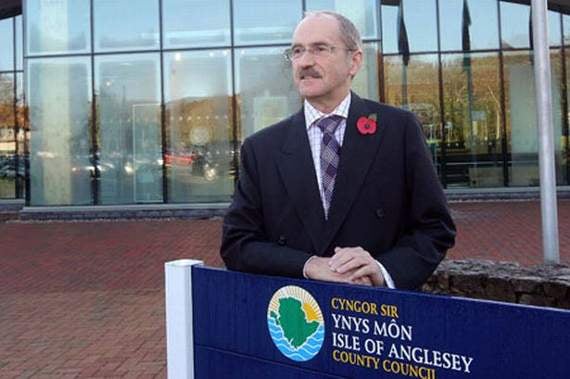
David Bowles
Council trouble shooter David Bowles is a controversial figure, who was praised after blowing the whistle on a council leader’s criminal actions when Bowles was chief executive of Lincolnshire County Council. In 2004 council leader Jim Speechley was jailed for 18 months after being convicted of misconduct.
Since then Mr Bowles, of West Parley by Bournemouth in Dorset, has been appointed to help turn around struggling authorities and organisations.
His most recent high-profile appointment in 2009 saw Local Government minister Brian Gibbons install him as managing director of Isle of Anglesey County Council after the Wales Audit Office found serious failings in the way it was run.

A Freedom of Information request revealed Solace Enterprises, described as a consultancy that helps councils and organisations ‘improve their overall performance’, was paid £1,160 a day to provide his services – plus VAT, travel and accommodation costs. At the time this made Mr Bowles the highest-paid civil servant in the Uk.
He is now director of David Bowles and Associates that advises councils on matters such as governance.
He has not made his East Hampshire District Council governance report, or his earlier preliminary report, public, saying it is up to the council to release it.
The council won’t say how much Mr Bowles has been paid to date, but says the total will be released in 2021.
Richard Millard
Cllr Richard Millard was deputy leader of East Hampshire District Council when he was handed the leader’s role in 2017 when the man widely viewed as his mentor, Ferris Cowper, stepped down. In handing over, Mr Cowper said he was anticipating a smooth transition, saying Mr Millard had ‘matured and transformed into a politician with leadership skills, who possesses the ability to accept the pitfalls of the job’.
They were seen as a political ‘pair’ until soon after Cllr Millard became leader, when he gradually began instigating a ‘culture’ change at the authority, which is currently based at Penns Place.
In March, Cllr Millard abruptly removed Mr Cowper from his cabinet post as portfolio holder for Whitehill and Bordon, with its focus on the eco-town regeneration of the area.
Cllr Millard, along with council chief executive Gill Kneller, commissioned independent local government expert David Bowles to undertake a governance review that looked into the culture of the council. It was found there was an ongoing culture of intimidation, bullying and fear at the council that could take a considerable time to change.
The culture had also cost taxpayers’ money as council officers, worried how their advice may be viewed, repeatedly took expensive legal advice to prevent suffering repercussions.
When asked why, when he was deputy leader, he and other senior cabinet members didn’t do more to change the culture, Cllr Millard said he felt it was only when he became leader that he felt he had the resources to tackle the issue.
Cllr Millard added: “I am truly sorry staff have had to deal with what is outlined in this independent review. The behaviours outlined in the review are totally unacceptable.
“Under my administration I will not tolerate these types of behaviours. I will make absolutely certain that if any behaviour like this is alleged, it is dealt with quickly and thoroughly through the proper processes. We take the wellbeing and mental health of staff and councillors extremely seriously.”
Ferris Cowper
Grayshott resident of more than 30 years, Ferris Cowper, now aged 71, was an East Hampshire District Council member for 21 years before he suddenly resigned in October.
His unexpected resignation followed his removal in March from the councils cabinet as the portfolio holder for the Whitehill and Bordon eco-town project, something the council didn’t announce until months later.
In March, council trouble shooter David Bowles was commissioned to carry out a governance review – that included a look into how the council had run before now.
Over most of the period covered by the Bowles report, ‘ten years’ is mentioned – Mr Cowper was either leader or deputy leader.
He served as leader from May 2013 to 2017, when he handed over to his long-serving deputy Cllr Richard Millard.
Mr Cowper was then deputy leader to Cllr Millard until 2018 when he was replaced by Cllr Julie Butler.
The former councillor has known about the Bowles investigation and report but declined to comment.
After his resignation, the council didn’t pay tribute to his time as leader, or as councillor. On being asked by the Post if his work would be acknowledged, the council would confirm only his resignation and list his roles.
Gill Kneller
Gill Kneller has been with the council since March 2005 when she was appointed its head of environmental services, so was with the authority during period covered by the Bowles report.
She was appointed chief executive in January 2019, and in December 2019 saw an email from the-then Cllr Ferris Cowper to council leader Richard Millard.
Part of it read: “I’m increasingly concerned we may have a case of corporate corruption here. Not personal corruption, but the council, corporately, putting money into its bank account by taking a decision improperly and lacking in full transparency.”
In March, Mr Bowles was commissioned to look into the contents of the email and he uncovered an historic wider culture of intimidation, and threatening behaviour within the council. He prepared a preliminary report which was presented in August; it said there was no basis of fact in Mr Cowper’s email.
But he found that during the previous ten years a culture existed that, among other ‘unacceptable behaviour’, saw officers threatened with the sack unless they followed ‘orders’. ‘This is how things are done,’ people reported to him.
In Mr Bowles’ preliminary report, seen only by Gill Kneller, Richard Millard and Standards Committee chairman Cllr Malcolm Johnson and deputy chairman Cllr Ginny Boxall, he detailed the allegations and named names.
The Standards Committee dealt with some allegations but others were dropped as the person – or persons – named were no longer a councillor. The Standards Committee outcomes won’t be made public, says the council.
The authority says it wants to move forward and won’t name the person – or persons – whose actions were detailed in a lengthy part of Mr Bowles’ preliminary report, that was later removed from his draft final report and won’t now be published.
When the chief executive was asked if this was a ’cover-up’, a council spokesman said: “The chief executive and the leader have tried to be completely open and totally transparent. They have tried at every single point to do the right thing in the most open way possible, from commissioning this report right through to pushing for every aspect of it to be made public.
“The only thing stopping them from being as open as they want to be is the law that protects individuals. Ignoring this law could put the organisation at risk of a defamation claim.”
Comments
This article has no comments yet. Be the first to leave a comment.