
Things are starting to begin for the growing season ahead.
All the planning and seed ordering has been completed and I am just waiting on my the remainder of my seeds and potatoes to turn up.
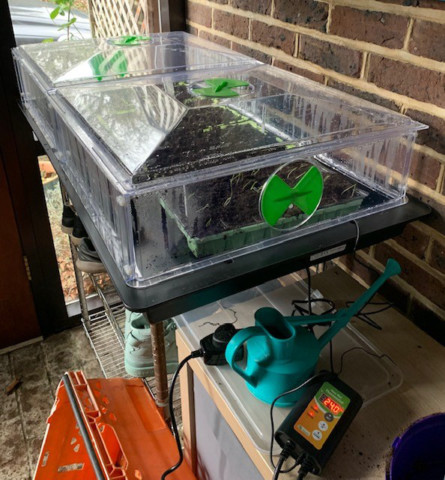
Onions, leeks, chilli and aubergine seeds have all had a first sowing and this year I have decided to treat myself to a new propagator (pictured top).
It’s like an incubator for seeds, a mini greenhouse made of plastic, with vents so you can manage the temperature inside.


I’m not sure how the kids feel about it being in the porch, but I think it’s brilliant!
And I’m not really sure how I have coped without one in the past.
It fits 12 half seed trays in, giving the seeds a great start – a game changer!
Tomato seeds will be going into the propagator in the next week or two.
If you have not ordered your potatoes yet, there are plenty on offer at the garden centre and now is the time to start thinking about ‘chitting’ them.
This is the process of letting the seed potato start to sprout shoots before planting.
This needs to be done in a well-lit frost free place and egg boxes are the ideal way to keep them.
I actually remove some of the shoots, leaving me with 2 or 3 on each seed potato.
In my opinion this improves the quality of the crop; you get a few less spuds, but much better size and uniformity.
There is of course no real need to do this if you are just growing for the table – but as you know I enjoy growing for the show bench too!
At my new house not only have I inherited a very lovely garden with some very healthy and well stocked herbaceous borders but six fruit and veg beds too.
At one end of one of them, and starting to show signs of life, are some rhubarb crowns (pictured above).
I must confess I am not the biggest fan of rhubarb.
But I have done some research and it would seem it’s a fairly straightforward plant to grow and can last for a long time, 10 years or more in some cases.
It’s a big plant so is not ideal for being grown in small spaces or containers, it does best in free draining soil where there is little competition.
Plant the crowns between October and March in a well dug bed with plenty of organic matter added.
Make sure there is about 1m between plants and they are just a few cm below the surface, and water well.
Every summer the plant will produce a seed stalk.
This is best removed to allow the plant’s energy to go into stalk production rather than into seeds.
In the autumn the leaves die back and should be removed and the plant can be heavily mulched with compost or well-rotted manure.
In February as the buds start to appear add a handful of general-purpose fertilizer, you could try ‘forcing’ the rhubarb?
This produces a really sweet and tender crop.
Place a large container (such as a black plastic dustbin) over the plant as soon as it sprouts in late winter, early spring.
The extra warmth promotes growth and pale, tender stalks after about four weeks.
It’s important not continually force any one particular plant as you will exhaust and kill it.
It must have at least one, preferably two years, before being forced again.
Ideally, have several plants you can alternate with forcing.
Feed the plants after forcing and discontinue picking after the pale stalks are taken; I am off at the weekend to get a black bin to give it a go!
Comments
This article has no comments yet. Be the first to leave a comment.