
Most people know what a food bank is. They’ve sadly become commonplace over the last two decades, even in relatively affluent places like Farnham.
But ask people what a hygiene bank is, and some will look puzzled.
Yet the charity The Hygiene Bank is working across the UK, trying to support those living in hygiene poverty.
Hygiene poverty is not being able to afford to keep clean, something that affects more than just a few. An estimated 8.7m adults miss work or job interviews and one in ten children skip school because they cannot afford basic products which many of us take for granted.


What? Even in leafy Surrey? In verdant Hampshire?
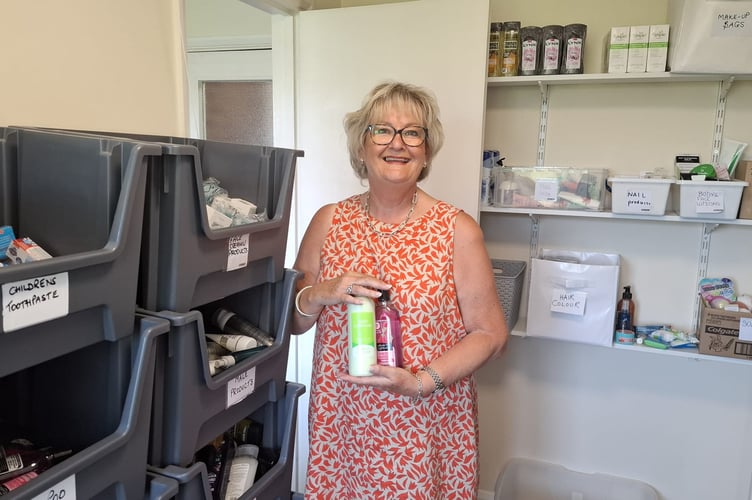
Yes, The Hygiene Bank can be found across both counties and is particularly active in Farnham where co-ordinator Helena Vernon has a team of volunteers who buy or collect hygiene products – soap, shower gel, toothpaste, washing detergent, toothpaste and the like – to give out to community partners across the area.
These are local organisations which support children, families and individuals in need with partners including Hale Community Centre, Brambleton Hall, Creative Response, Weydon and Farnham Heath End Schools and St Mark’s Church, Upper Hale.
“Our community partners come to our storage facility and choose products most suitable for the people they are supporting,” said Helena.
“Having essential hygiene products makes a real difference to families and individuals.”
The Hygiene Bank’s underlying philosophy is that “basic hygiene is not a privilege”.
However, many people are being forced into making difficult decisions between buying hygiene products or food, or buying products for children but going without themselves, and the numbers seem to be rising.
The charity In Kind Direct recently reported that 46 per cent of teachers have now seen children bullied because of their hygiene issues, and the anti-poverty charity Turn2Us has found that 80 per cent of teachers have seen an increase in the number of pupils coming to school unwashed.
We might think this doesn’t apply in our towns and villages but Helena cites cases which she knows directly.
“There was a family with teenage girls who would skip school when they had their periods because they couldn’t afford period products,” she said.
“But once we were able to provide them they were back in school and taking part in everything.
“Then there were some Farnham boys who were being ostracised and beaten up at school because they smelled so they stopped going to school until we provided washing products and deodorant.
“There was also a family who had just one toothbrush between them and no toothpaste. We were able to give them the toothbrushes and toothpastes which suited the children’s ages and the adults too.”
These are just three examples and with many people not knowing where to go for hygiene support, it’s the tip of the iceberg.
Last month one of the charity’s community partners supported a woman who said she had been trying to get hygiene products for a while. She didn’t know where to turn until she was told on social media about the partner.
“If anyone needs help they can go to the Citizens Advice Bureau who have a list of Hygiene Bank partners,” said Helena.
“Or the Foodbank. They aren’t a partner round here because they are often given hygiene products themselves but if they don’t have what is needed they will be able to say where to go.”
The Hygiene Bank differs from the Trussell Trust foodbanks in that no referrals are needed (the Trussell Trust requires foodbank vouchers for those using the service) and leave any decisions about giving out products to the individual partners.
Of course, the hygiene products don’t magically appear out of nothing; they are donated or bought and all of this requires funds, hard work and good will.
“I have two volunteers who do the shopping and they are very careful, always finding where there are special offers and looking for good value for money,” said Helena.
“All the money is spent wisely. We apply for grants for this and sometimes have donations of money.”
Donations are the source of most of the stock and there are donation points across the area. Pop into Boots in Haslemere, The Nationwide in Alton, The Spire Church in Farnham – just three of the places where you will find a bright yellow bin with The Hygiene Bank in black lettering.
The donation points can all be found on an interactive map on The Hygiene Bank’s website where there is also the opportunity to give financially.
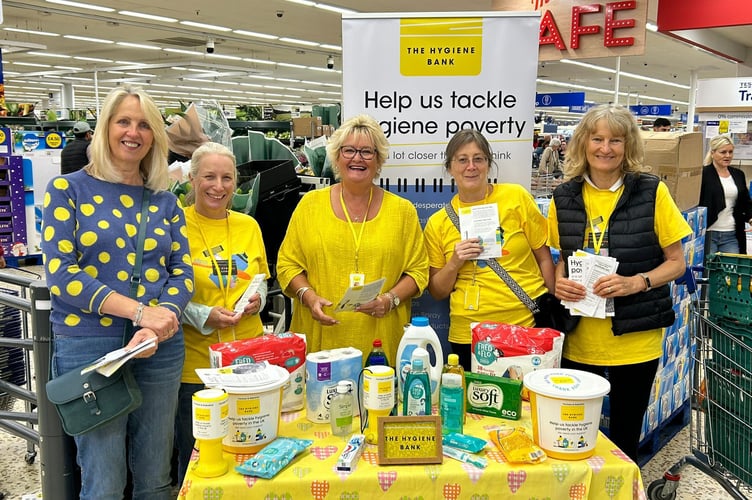
The bins are emptied regularly by volunteers who then sort the products ready to give to the partners.
In the storage rooms in Weybourne everything is neatly stored in appropriate containers: tampons in one, deodorants in another, razors in a third and so on.
When a partner visits to collect stock, they choose what they need and it is put in bags and weighed, in order to gauge how much is going out.
“At the moment we have 14 volunteers and we are always looking for more,” said Helena.
“We have a lovely group who just get on with it and anyone who wants to join us doesn’t have to do more than two or three hours a month. They can fit it round other commitments.”
Helena herself is a volunteer and feels passionately about the charity as she knows what it is like to struggle financially. Her passion means that The Hygiene Bank’s reach has grown in the three-and-a-half years since she took on the role of co-ordinator and she wants to grow it further.
“We are looking for new places to have our collection boxes and new partners too,” she added.
She and the other volunteers regularly collect outside supermarkets.
“We have a shopping list which we give to people going in and we ask them to buy just one extra thing with their shop,” said Helena.
“In Morrisons in Aldershot you can actually pick up a special bag of hygiene products and, once it has been through the till, it goes directly to us.
“We also give presentations to schools and groups. A school will first ask pupils to bring something in – it can just be a toothbrush or soap – and we talk about what we do then take all the donations back to the storage place.
“We gave a presentation to a knitting group at The Spire Church in Farnham and they gave us shoeboxes full of hygiene products which we could give as gifts.”
There are rules about what can and can’t be given, but basically all donations must be new, unused, in-date personal care and household cleaning essentials.
For health and safety reasons, opened, half-used or products past their best-before date cannot be accepted. A full list of what is needed and what cannot be accepted is on The Hygiene Bank website.
Hygiene poverty has been described as a ‘hidden crisis’. After all, how many people want to admit that they can’t afford basics like soap and toothpaste?
It is around us all the time, even in seemingly affluent areas, and the call on The Hygiene Bank continues to grow.
“Hygiene poverty,” said Helena, “is nearer than you think. Please support us.”
Comments
We've recently changed our login process. If you have an account for commenting, you will need to re-register on the login window.
This article has no comments yet. Be the first to leave a comment.