
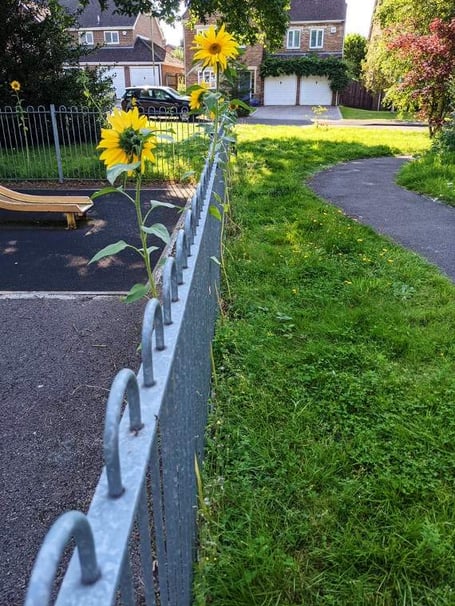
DISCOVERING the council responsible for weedkilling childrens flowers has uncovered a tangle of contracts that benefit councils – but not the children.
It has also been revealed that a weed killer containing the potentially harmful chemical glysophate is still being used around plays areas and other public green spaces.
Two councils are responsible for controlling weeds, Hampshire County Council, roads and footways, and East Hampshire District Council on land it is responsible for, such as play areas.
But they have subcontracted the spraying to EHDCs partner council Havant Borough Council -- EHDC is paying Havant £30m over ten years for a whole range of services including emptying wheelie bins and spraying weeds.
-Amber-warning-for-cold-weather.png?width=209&height=140&crop=209:145,smart&quality=75)


But Havant in turn sub contracts the services to contractors Norse South East, a company the council jointly owns with Norfolk County Council.
EHDC and Havant chief executive officer Gill Kneller, then a director at Havant, was also made a director of Norse South East soon after it was formed in November 2015.
She was made interim joint chief executive of EHDC and Havant in January 2019, and resigned as Norse director in February 2019.
In September 2019 through a complex deal, Havant owned Norse began providing services to East Hampshire District Council, including bin emptying and weed spraying.
About three weeks ago, Norse operatives contracted to Havant, were weed spraying across the town on behalf of EHDC, and Hampshire.
Unintentionally and accidently, they weedkilled sunflowers children had planted around the Lower Mead play area, much to the youngsters distress.
Although not directly responsible for the contractors, or the error, EHDC stepped up saying it took responsibility for the mistake.
In a statement the council said: “We are so sorry for making this mistake.
“It was a genuine error which led to some of the smaller plants being sprayed with weed-killer.
“Once the operative realised his error, the work was immediately stopped.
“The council is responsible for many open areas around the district and has a busy schedule keeping on top of fast-growing weeds.
“However, we have a process in place to stop this kind of mistake and it is up to us to make sure that it doesn’t happen again.
“We are so sorry for the children who planted the sunflowers and we hope that it won’t put them off brightening up the play area with these wonderful plants in the future.”
The council says it has reduced the use of glysophate based weed killer in line with it’s Climate and Environment Strategy, but admits weedkiller with a safe level of the chemical is still used.
Although using contractors Norse to weedkill, Hampshire County Council said the play area wasn’t part of the contract.
Hampshire county councillor Russell Oppenheimer of Russell Way off Sussex Road is the council’s Executive Member for Highway Operations.
He said: “I was very sorry to hear that the sunflowers planted by local children appear to have died.
“However, having checked with our contractor, I can confirm that the Lower Mead play site was not part of the recent weed treatment programme.
“Only the footways, kerbs and drainage channels were treated in order to keep them free of weeds, which can damage the structure of the highway.
“The county council has an annual programme of weed spraying treatment and this is undertaken by a specialist and accredited contractor.
“Spraying is undertaken in a safe and controlled way using a ‘controlled droplet application’ method, to prevent overspray, and the herbicide is only applied directly to the weeds, and not as a blanket spray.
“The purpose of the treatment is to keep our footways, kerbs and channels free of weeds as these can cause damage to the structure of the highway.
“An approved glyphosate based product is used, that does not present any residual impact on the environment, and only hard surfaced areas of the highway are treated, and not grassed areas.”
Comments
This article has no comments yet. Be the first to leave a comment.