
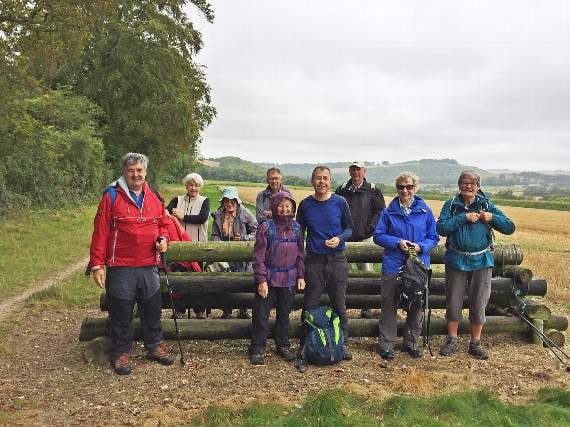
Petersfield Ramblers went on a walk through history from Harting Down, led by Hilary and Gordon Watts.
Harting Down is an area of ancient chalk downland, a mixture of grass and woodland. The area was inhabited in the Iron Age and a fort from that time can be seen at Beacon Hill.
On reaching the National Trust car park, one can immediately see why they chose it – the views for miles around are magnificent.
We are perched on top of the South Downs with the steeper north-facing scarp slope falling away from us towards the little village of South Harting with its copper-spired church. The village has another ancient connection as it was listed in the Domesday Book.


The more gentle dip slope of the South Downs leads southward to the sea, where it is criss-crossed by numerous chalk valleys. Our circular walk of eight miles first took us west along the South Downs Way, a long distance trail which stretches about 100 miles in its entirety from Winchester to Beachy Head near Eastbourne.
Turning inland through beautiful oak and beech woodland, we arrived at our first view of Uppark. Situated high on the South Downs and with magnificent views towards the sea, Uppark is a large 17th-century house now owned by the National Trust.
In 1989 it was devastated by a fire caused during work to repair the roof, just two days before it was due to be completed. The building was completely restored, with many lost crafts relearned in the process, and reopened in 1995.
The gardens and open spaces around the house make it a delightful picnic spot in the summer. However, this was for another day, as our walk took us down to the small and also ancient village of Compton.
Going past, with difficulty, the tea shop in the village, we climbed through more woodland to the long barrow called Bevis’s Thumb. Long barrows are burial mounds from the Early Neolithic period, which stretched from 3000BC to 2400BC.
Bevis’s Thumb is among the larger of the mounds, being around 60 metres in length and 16 metres at its widest point. Legend has it that it is the burial place of the giant Sir Bevis.
Our walk back to the car park gave us more views of Uppark from a different angle, and through woodland, where, unfortunately, ash dieback has resulted in widespread tree felling.
Gordon Watts