
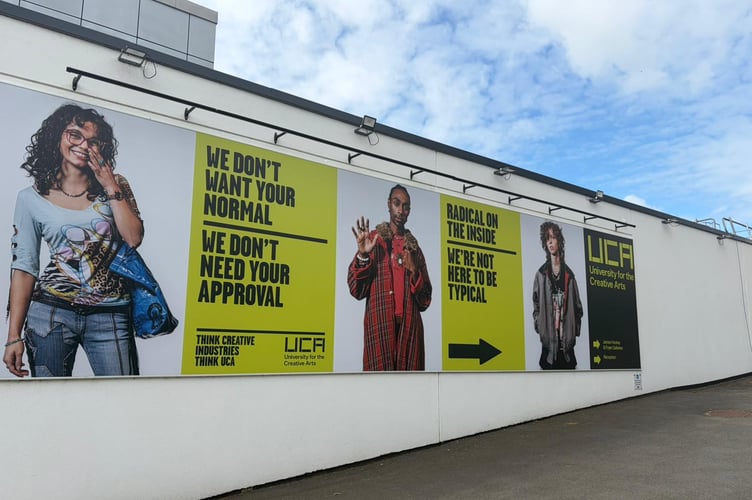
University’s ‘decline’ is not just about money
Allow me to remind you: Last place for graduate prospects and 127th out of 130 universities. But it doesn't ask as to why it has performed so badly.
The response from UCA was: “It is well reported that the higher education sector is facing unprecedented financial pressures. The University for the Creative Arts, like many others in the sector, is not immune to these pressures.”

Whilst this is accurate, it avoids the blindingly obvious question as to why UCA is firmly rooted to the bottom.
Having taught on the film production course from 2019 to 2021 (leaving entirely of my own volition), it was patently obvious that some of the staff didn't have sufficient and relevant film industry knowledge to impart to students.
In addition, the lack of equipment and space also led to disenchantment amongst many of the students.
The lack of academic robustness - students were given over-inflated grades on some modules and, in some cases, appeared to pass although not completing the module – was indicative of weak course leadership allied to academic rigour that wouldn't pass muster at the better universities I've taught at.
The film production course - both BA and MA - was, at the time, the cash cow for UCA.
In 2020, the entire cohort for the course was around 400 students, with about one third coming from abroad and paying twice the fees of UK students.
A significant proportion of the overseas students didn't have sufficiently good English to be able to communicate clearly, on a course heavily reliant upon verbal communication.
Many UK students brought this up as a continual source of frustration and anger, but UCA appeared to ignore this, probably as a consequence of the, then, vice chancellor's need for more revenue to build more student accommodation.
One only has to look at the turnover of vice chancellors and staff churn at UCA in the recent past to realise that it's not simply financial constraints that have impacted on the student experience at UCA.
Dean Humphreys,
Farnham
Local change is rarely simple
Honesty in politics matters most not in grand speeches on national stages, but in the everyday promises made to local communities.
Nowhere is this clearer than in places like Bordon, where people were once sold a vision of transformation. A “dream” of regeneration, opportunity, and a better future, only to feel, over time, that those promises have not been fully honoured.
It is easy to stand in front of a community and pledge sweeping reforms, quick fixes, and immediate change. Big visions capture attention and generate hope.
But when those promises are not matched by delivery, that hope can quickly turn into frustration. For many in Bordon, the gap between what was promised and what has materialised has led to a sense of being let down.
The truth is that local change is rarely simple. Regeneration takes time, funding is finite, and competing priorities can slow progress. That is precisely why honesty matters.
Communities deserve clarity about what can be delivered, when it can happen, and what obstacles may arise. It is far better to set realistic expectations than to overpromise and risk eroding trust.
For me, delivering honest reforms means learning from experiences like Bordon. It means listening carefully to residents, understanding what has and hasn’t worked, and committing to practical, achievable improvements—whether that’s infrastructure, housing, or local services.
It also means being upfront: saying what can be done now, what will take longer, and where limitations exist.
Overpromising might win support in the short term, but it often leaves communities feeling overlooked in the long run.
Honest leadership, on the other hand, builds credibility.
Bordon’s experience should serve as a reminder that communities are not looking for perfection or grand illusions. They are looking for integrity, accountability, and results they can see and feel in their daily lives.
If we are serious about rebuilding trust, we must move away from selling dreams and instead focus on delivering reality openly, honestly, and consistently.
Tasha Vodden,
Reform UK Candidate - Whitehill, Bordon & Lindford
Kindness after a fall
I was going to write a letter complaining about the terrible state of the pavements in Alton after I had a nasty fall when I tripped over a raised, rickety, misaligned piece of pavement tile, outside Waterstones by the bus shelter.
The accident reminded me of the article on the front page of the Alton Herald (March 19) about Petra Sutherland’s fall. Although my headlong-long fall was not as serious as Petra’s, it injured an ankle that I had previously damaged, resulting in difficulty in walking and a painful swollen joint.
But on reflection, I decided instead to celebrate the kindness of strangers, who helped me – two young gentlemen who stopped to help me and then a young woman.
How kind and gentle they were! Having managed to get me up and onto a cafe chair, a waitress from the cafe came with a glass of water.
Once I had caught my breath, the young woman, who I later found out had been a carer to her mother since she was eight years old, gently walked me over the High Street to a cafe, once a bank, where another act of kindness was shown to me when the cafe waitress offered a drink of water or a coffee.
The waitresses sat me in a comfy chair and I phoned my friend to collect me.
Today we hear so much about the unkindness, rudeness and general bad manners, I wanted to say a public thank you to these young people and to celebrate the lovely thoughtful young people who live among us.
Susan Harvey,
Telegraph Lane,
Four Marks
Comments
We've recently changed our login process. If you have an account for commenting, you will need to re-register on the login window.
This article has no comments yet. Be the first to leave a comment.