
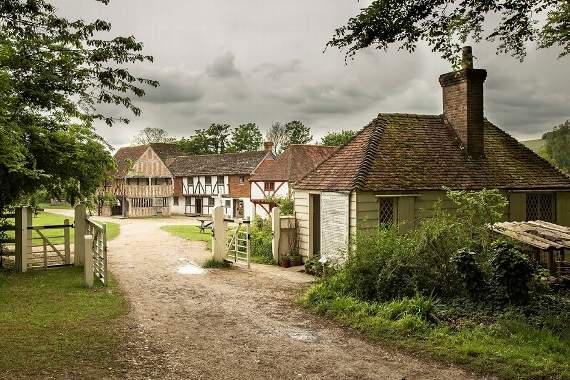
It was so exciting to be going to look around the Weald and Downland Living Museum now it's open again after being closed during the pandemic, writes Jane Bartlett.
I had forgotten how lovely the drive from Petersfield was and driving along B1246; the South Downs looked so magnificent.
On arrival I met museum marketing manager Emma Keen and as we walked and talked, the only sound disturbing the delightfully warm, sunny peace and quiet was the birdsong.
There are 53 historic, rare and old buildings spread throughout the wonderful 40-acre museum landscape – a landscape that is home to farm animals as well.
Lovely saddleback pigs, working horses and sheep; their lambs will be born in the next few weeks. What’s not to like?
At a pair of lovely Victorian farmworkers’ cottages, cultural engagement manager Lucy Hockley showed me a long-handled water pump that has been reinstalled in the garden.
Along with the mangle and washing line, visitors could see how life used to be – the tin bath is outside as well.
And at the nearby tiny Victorian school, a suitably-attired volunteer enthusiastically explained about those long-ago school days.
Goodness knows what Victorian schoolchildren would have made of the past year!
Further on, we met the museum’s working animals supervisor Andy Robinson, and Oli – a huge, handsome dapple grey Percheron carthorse.
Oli was harnessed to a cart of manure and was standing patiently while Andy, wielding a pitchfork, unloaded it on to the muck heap.
There are now three working Percherons at the museum – Oli, Kash and recent addition Leon.
Leon is an 11-year-old gelding and occasionally all three of these beautiful beasts will be out working together this summer. What a fantastic sight!
Work hasn’t changed or stopped for Andy during the lockdown, but he did say he had missed not being able to visit the local pub.
After saying goodbye to Andy and Oli, we walked to Bay Leaf Farmhouse to meet museum head gardener Carlotta Holt.
During lockdown, Carlotta and her team have been busy in one the museum’s six delightful gardens, each based on different historical periods.
Bay leaf garden reflects what a 13th-century ‘yeoman’ farmer would have grown; what many modern gardeners call weeds would have then been used for medicinal and household purposes.
Carlotta was busy sewing Martock beans, a 13th-century variety of broad bean, peas, shallots and onions and garlic in the fenced-in garden.
The Hazel hurdle fencing is to be replaced this year , and visitors will be able to see the hurdles being made.
However, Carlotta pointed out it doesn’t keep pigeons out and they’ve been busy eating the sweet rocket!
The produce they grow is used in the museum’s Tudor kitchen and its cafe.
After admiring the cherry plum blossom, we walked on to a beautiful little flint cottage that had just been re-thatched.
The roof was like a golden glowing crown and it felt like we were in a nursery rhyme film.
The museum hires out its buildings for films and you can get married there, too.
In the nearby wood yard we met Julian Bell, working among the traditional sawpits and steam-powered mechanical saws and crane.
He was making hurdles out of sweet chestnut, and many years ago this portable fencing was used by downland shepherds to corral their flocks.
From the wood yard we joined the sculpture trail, with its iron sculptures made by the British Artist Blacksmith Association to help identify the different types of trees.
It was so atmospheric in the woods it reminded me of the Hansel and Gretel fairytale.
The museum is putting on a children’s theatre production Wonders with Grimm in August – it won’t disappoint, I’m sure!
Leaving the trail, we admired the market square surrounded by historic buildings.
I had mentioned to my sister I was visiting the museum and she said The Repair Shop on BBC 1 was filmed there, and Emma kindly took me along to the ‘workshop’.
We then saw the working water mill, one of just a few in the UK; its flour can be bought in the gift shop.
Walking past the museum lake reminded me of a visit many years ago with my young children.
After a lovely walk round, my youngest son threw his brand-new shoes in to see if they would float. One did, one didn’t.
Now he’s anxiously awaiting the birth of his first baby – I may remind him of that day as a warning of things to come!
Before I left we met with Jon Roberts and a volunteer who were hedge laying. How easy they made this skilled task look.
Jon is only too happy to explain the wonderful working life of the countryside.
Emma added: “ There is something very restful about the atmosphere here.
“Our buildings and architecture give visitors a real connection to the past, and I think that leads us all to reflect and see our present with fresh eyes.
“There’s also a chance to learn something, from historical facts to new skills, and people often leave with a real sense of achievement at having improved themselves.
“It’s undoubtedly a beautiful place to work and it’s very satisfying to see how happy and relaxed visitors are after their visit.”
The dog-friendly museum is now open for booked visits, and for membership details and to book a visit, see the website at https://www.wealddown.co.uk
Comments
This article has no comments yet. Be the first to leave a comment.