
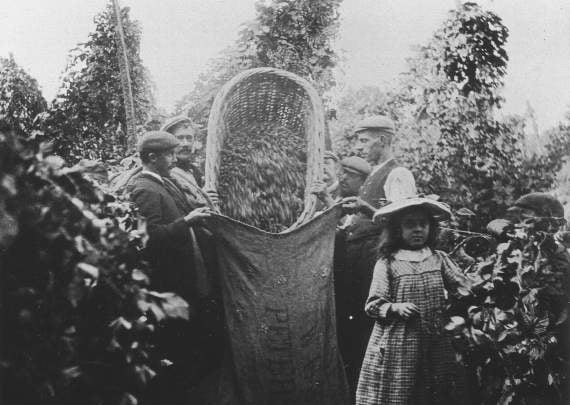
A 90-FOOT long machine made front page news in the Post’s forerunner on September 10, 1958.
Headed ‘End of an era’, the article and photograph in The Hants and Sussex News reported on how automation had come to hop-picking.
Mr JK Winser, who owned the hop gardens at Weston, was reported saying: “I would much prefer to pick them the old way but this is an economic necessity.”
The report continued: “The machine is called a bruff and for the past two years it has been used in hop fields across the country. Now, says Mr Winser, the majority of hop farmers are using it.



“It has done its job ‘quite well’, according to Mr Winser but he is hoping it will work better as the days pass. Over 200 people are employed in the hop garden this year and this number includes those carrying the hops to the kiln.
“The vine is cut and carried to the machine which strips it and then, in another section, the leaf and stalk is sorted from the hop.
“There is no doubt that this machine will mean the end of hop-pickers. About 80 per cent of the Worcester and Hereford crops was machined last year, said Mr Winser, who, this year, has only one complete family employed in the gardens.
“However, there are nearly 300 hop-pickers in the gardens of Major HL Rose’s estate at Buriton, which formerly belonged to the late Lt-Col AL Bonham Carter.
“Exactly the same system has been employed this year as when Col Bonham Carter was alive,” The Hants and Sussex News stated.
“About 80 of the pickers are living in wooden hutments near the gardens, while others come every day from Portsmouth and the nearby district.”
Hop growing around Buriton and Weston ceased in the late-1960s. It is believed that hops had been grown in the area for about 150 years.
Both the Bonham Carters in Buriton and the Sewards in Weston won many awards for the quality of their hops.
In latter years the main fields used for hops in Buriton were those along Pitcroft Lane and hops can still be seen growing wild in the hedgerows there today. But there are also memories of hops being grown on what is now the Recreation Ground – or Ten Acres field – in the early 1900s.
Hop-picking usually took about three weeks around September and village children were all expected to help and were given time off school.
Casual labour, mostly from Portsmouth, was employed as well as local pickers with many of the Portsmouth families coming back year after year to camp or live in huts.
Community local history project Buriton Heritage Bank has collected photographs, first-hand accounts and information about the hop gardens of Buriton and Weston which can be seen on its website at: www.buriton.org.uk/history/hop-growing-and-hop-picking/ and there will be displays at the annual Bygone Buriton exhibition at St Mary’s Church in the village on September 29.