
IT’S A DISCOVERY we all take for granted nowadays but the discovery of how to harness radio waves excited many people a century ago.
As with our current generation of young people interested in applications of computer science, forward-looking schools, such as Bedales, the independent school at Steep, near Petersfield, encouraged its pupils to investigate the latest scientific developments.
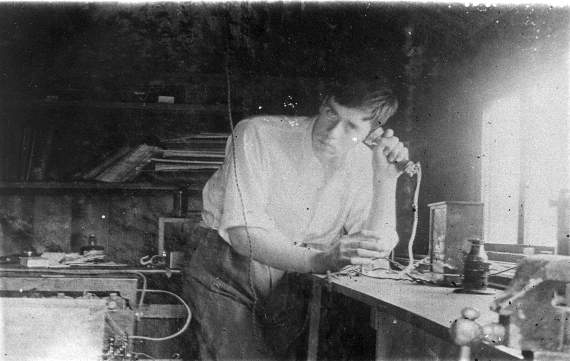
In 1908, thanks to two of its pupils, the school became the first in the country to have its own radio transmitting station and one of those boys went on to become what could be described as the first DJ and the first chief engineer at the BBC.
That boy was Peter Eckersley, the son of a railway engineer who was in charge of building the Great Mexico Railway when his younger son was born in 1892. He and his older brother, Thomas, who also attended Bedales at the beginning of the 20th century, were cousins of the writer and philosopher Aldous Huxley.
Peter joined Bedales in 1902 and was encouraged in his interest in radio. The enthusiasm of the teenager and his friend, Robert Best, led to them being allowed to set up a radio workshop in the grounds, known as Wavy Lodge.
On leaving Bedales in 1911, Peter went to Manchester University but he fully acknowledged his educational debt to his school, writing in 1943 it (Bedales) “gave one the opportunity to dream dreams and the stimulus to want to make the dreams come true.”
Following war service with the Royal Flying Corps and some time working with Marconi Wireless Telegraph Company, by 1920, Peter had become an announcer, broadcaster – he recited poetry and sang songs – and engineer of 2MT, the first licensed radio station in Britain, located in Writtle, near Chelmsford, Essex, where Guglielmo Marconi had built his wireless telegraphy factories.
The programmes would consist of records, spoofs, plays and other music. The station was initially allowed to transmit its test transmissions for only half an hour a week.
Dame Nellie Melba made one of the first broadcasts from 2MT at 7.10 pm on June 15, 1920, consisting of a concert of opera music.
Peter was the first Chief Engineer of the British Broadcasting Company Limited from 1922 to 1927 and then Chief Engineer of the British Broadcasting Corporation.
After resigning from the BBC in 1930, he was involved in building broadcasting stations in Europe.
Recognition of Peter’s pioneering career in broadcasting is documented in the radio and television collection at Amberley Museum and Heritage Centre in West Sussex.
His brother, Thomas, also made a career from work in the new field of radio communication but, as a physicist, he worked for Marconi, becoming its chief scientific officer.
As a tribute to the brothers’ outstanding contribution to scientific progress and thinking, Bedales has an annual lecture in their name by an eminent scientist.