
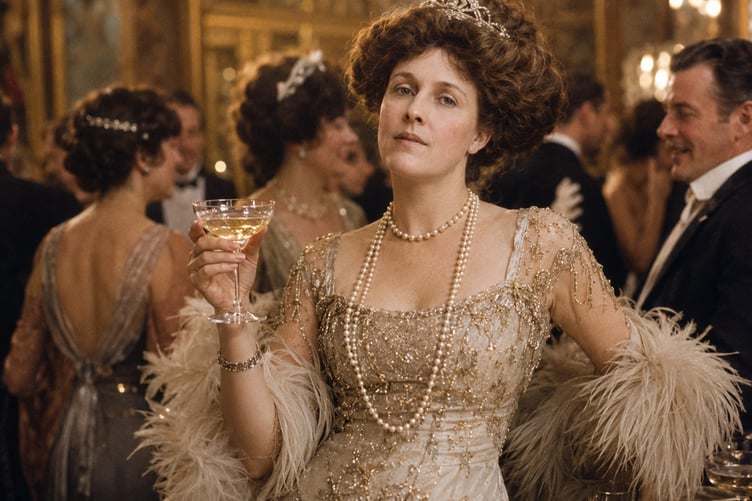
Charles Charrington, who built Frensham Hill (now Frensham Heights) and was renowned for his lavish parties, was involved in one of the great Victorian scandals, writes Roy Waight.
In 1889, aged 30, he married Monique Lilly de la Pasture, a society beauty also known as Monica Ducarel. His optimistic plan to divide his time between his London residence in Pont Street and a country mansion was thwarted by Monica's adulterous liaisons, and the couple eventually alternated between his properties, each using them as a refuge from the other.
Monica was born in New Zealand in 1869 to a family of minor French aristocracy. She and Charles Charrington had a daughter.
Her infidelity reached the newspapers in 1896 when she was named in the Lord Cowley divorce case. Charrington became aware of her affairs in 1895, when the couple separated, and he granted Monica an extraordinary allowance of £2,000 a year. Some contemporaries assumed she had married him for his money.


Denied custody of her daughter and apparently abandoning her, Monica subsequently divided her time between London and Paris while continuing to enjoy life as a society belle.
She began an affair with George, Lord Bullough, the immensely wealthy and handsome bachelor and playboy who was well known for breeding racehorses. When Bullough received his knighthood in 1901, some wondered whether it was, at least in part, for services beyond those rendered during the Boer War.
It was alleged that Monica had become one of King Edward VII's mistresses, and Sir George agreed to be named as the correspondent in the Charrington divorce case to keep the King's name out of the newspapers.
Monica's 13-year marriage to Charles Charrington ended in 1902. The divorce was finalised in 1903 and, a month later, Monica and George married.
Monica became Lady Bullough, chatelaine of Kinloch Castle on the Isle of Rum in the Inner Hebrides. She and her husband led largely independent lives but appeared happy together.
One wonders what Charles Charrington thought of the extraordinary antics of the later Lady Bullough.
Kinloch Castle became a kind of Edwardian Love Island, and the debauched parties held there scandalised society.
Sir George's father, John Bullough, made his fortune manufacturing cotton machinery and bought the Hebridean island of Rum as a hunting estate.
His son inherited the island in 1891 on his father's death. In 1897 he ordered the construction of Kinloch Castle to replace the existing hunting lodge. It was an enormous structure designed as a pleasure palace.
The ballroom was designed so that no one could look in. The centrepiece was a ballroom hung with rich silks and exotic animal skins. A silk screen was discreetly erected across the balcony to prevent musicians from seeing the antics below. Even the serving hatch was designed to stop curious butlers from taking a peek.
Lady Monica Bullough became the most beguiling woman ever to lay claim to a Scottish island. Kinloch Castle was a place of lust and intrigue.
In the grounds, tropical peaches grew in greenhouses, hummingbirds flew free and a menagerie of alligators and turtles roamed the colonnades.
Male staff were reportedly required to wear specially designed kilts that showed off their physiques, while chorus girls were brought from Oban by chartered boat.
On the bedpost of one particularly well-appointed bedroom is the outline of bite marks said to have been made by Lady Bullough herself. Some referred to the castle as a royal brothel.
Monica had a reputation in London as a wild and sensuous woman with many lovers. She was given free rein to entertain her partners when Sir George was absent.
When the castle was sold, it was said that a sadomasochistic cage was discovered in the cellar. King Edward VII himself visited the castle. Sir George maintained a library of pornography and, on the old Steinway piano, scratches can still be seen that were reportedly made by women dancing in stiletto heels.
Lord Bullough died while playing golf in France in 1939, but Lady Monica outlived her husband by nearly three decades, dying in 1967 at the age of 97.
Had Charles and Monica not divorced in 1903, one wonders whether Frensham Hill might have become famous for more than cricket matches.
Roy Waight is chairman of the Farnham and District Museum Society. Anyone interested in joining the society can do so via its website, farnhammuseumsociety.org.uk.
Comments
This article has no comments yet. Be the first to leave a comment.