
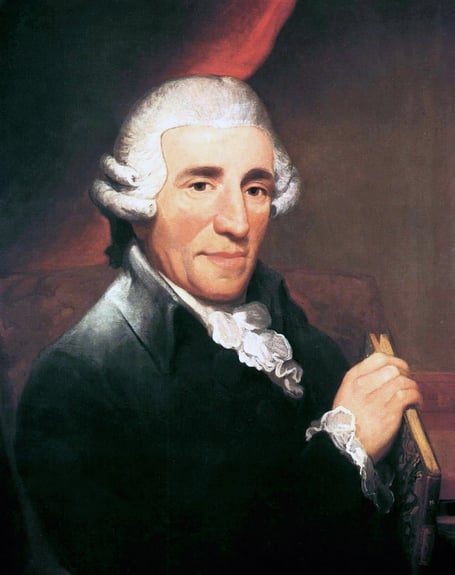
How many people know that Haydn visited Farnham? Twice.
Sir Walter Scott’s visit to Waverley is well known, not least because it inspired his Waverley novels, writes Roy Waight.
An even more significant figure in the arts also visited Waverley and had a passing connection with Farnham — the great Austrian composer, Joseph Haydn.
He visited England twice: first from January 1791 to June 1792, and again from February 1794 to August 1795. Haydn was then widely regarded as the greatest composer in Europe. Mozart had died three years earlier, and Beethoven was only just beginning his meteoric career. Haydn was, indubitably, number one.


Haydn was warmly received by London society and performed at major venues, and he even mingled with royalty. George III offered him a home at Windsor Castle if he would move to England permanently, but Haydn politely refused.
During his second visit, Haydn travelled well beyond London and was feted wherever he went. His diary became a whirl of social engagements and visits to salons, where he met aristocrats, as well as reconnecting with an old flame, Rebecca Schroeter.
She had fallen in love with Haydn during his first visit. Haydn, whose marriage was famously unhappy, had wanted to marry her, but, as a Catholic, he could not.
Haydn also found time for various excursions to estates in Surrey, Kent and Cambridge, visiting patrons and enjoying his fame before preparing to return to Vienna.
He gave his final London performances and began wrapping up his affairs and saying farewell to friends and patrons. But so great was the warmth of his reception in England, and so great the opportunity to earn a considerable amount of money, that he did not in fact leave until August 1795. Rebecca Schroeter may well have played a part too.
It was in August that the Waverley visit occurred. Haydn visited its wealthy owner, Sir Charles Rich, on 26 August, 1794, and Sir Charles took him to see the ruins of Waverley Abbey.
This moment is quietly evocative: Haydn, the great Classical composer, wandering among medieval ruins in the Surrey countryside. It is easy to imagine how the tranquil decay of Waverley Abbey might have stirred his imagination — especially given his deep love of nature and history. We know of the visit because Haydn kept a detailed diary.
The reference to his August visit reads as follows:
“On 26 Aug. 1794 I went to Waverly (sic) Abbey, 40 miles from London, to visit Baron Sir Charles Rich, quite a good ‘cello player. Here there are the remains of a monastery which has already been standing for 600 years. I must confess that whenever I looked at this beautiful wilderness, my heart was oppressed at the thought that all this once belonged to my religion.”
How had Haydn become acquainted with Sir Charles? We know that Sir Charles, though not a professional musician, was respected in musical circles and likely hosted Haydn for both social and artistic exchange. Sir Charles Rich lived in Surrey, not far from Haydn’s London base, and was known to host musical gatherings. It is plausible that Haydn was invited to Rich’s estate as part of a summer social excursion, and that he was attracted by the chance to see Waverley’s picturesque ruins.
The other visit Haydn made to Farnham seems to have been in July, when he was returning from Portsmouth, when he made a pencil entry in his diary which reads simply: “on the way back, a good meal at Farnham”.
It would be good to know more about this. Presumably he stopped off at Farnham because it was roughly on the route between Portsmouth and London. Had he been an Anglican, he would surely have been invited to stay at the Castle. One wonders whether, instead, he might have stayed at the Bush Hotel.
Roy Waight is chairman of the Farnham and District Museum Society. For more information visit www.farnhammuseumsociety.org.uk
Comments
We've recently changed our login process. If you have an account for commenting, you will need to re-register on the login window.
This article has no comments yet. Be the first to leave a comment.