
A ‘BODY’ has been found on Petersfield Heath. Or, at least, the Bronze Age remains of one.
And the nationally-important find – an unassuming pile of cremated and deteriorated bone – has hugely excited, and surprised, archaeologists.
As they hit evidence of a trench dug in the 18th century across the latest barrow being excavated they thought grave thieves of two centuries ago might have got there first.
But they were delighted to find that the robbers had missed the grave goods by inches, and everything was still in place.


Volunteer Terry Clemens, a regular on the People of the Heath digs, being run with Petersfield Museum, which are piecing together the ancient history of the landscape here, struck gold.
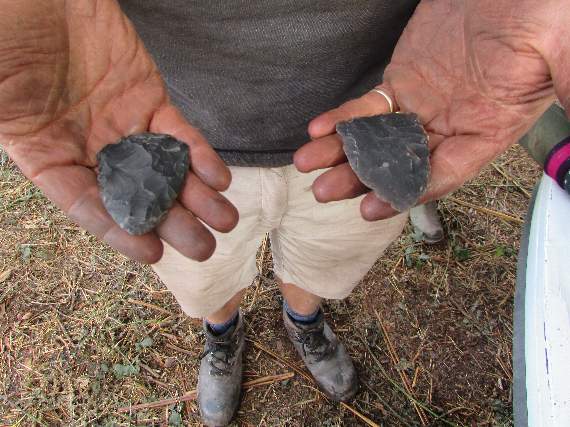
In the final days of the three-week long excavation of three barrows on Music Hill he found a 22.5cm long whetstone, which led to the discovery of ten flint blanks – a flint to be worked into an arrowhead – and the cremation.
“When we hit the trench we thought we had had it,” said George Anelay, project co-director. “Someone had tried to rob this barrow, maybe in the 18th century. But the guys who raided this just missed the burial.”
The cremation remains will now be sent off for carbon dating. It is hoped to be able to put a date to them, and to perhaps find out the sex and age.
It would have been an important person buried there, with such impressive grave goods including the whetstone, probably the largest yet to have been found from the early Bronze Age.
Also found in the intact grave was a ‘handle-like’ object, suggesting a bag, perhaps of leather, had contained the bones.
The handle was an unusual find in this context, according to co-director Dr Stuart Needham.
“It suggests a degree of ceremony was involved in the carriage of the individual’s remains to the burial site and may imply that the act of cremation took place elsewhere or at an early time.”
A finely worked flint knife that had been in the cremation pyre with the body was also uncovered.
Stuart is excited about the similarities with the barrow excavated last year.
There a whetstone and flints – and the prize find of a part of a bronze dagger – were found by the remains of a wooden burial box.
The similarities, for example the “exceptional” practice of placing flint blanks and not complete arrowheads at the graves, showed a repetition not usually found.
“We are beginning to wonder whether this particular type of grave assembly denotes a particular regional identity,” he said.
The excavations, although hampered by prolonged rain on some days, have once again captured the imagination of the public.
Residents have flocked to George’s end of day round-ups to find out the latest discoveries, and schoolchildren have loved getting their hands dirty.
“I have heard them say ‘this is the best day out ever’, which has been great,” said George.
People have been keen too to volunteer, many with no previous experience, including Emily Morris (25), of Petersfield.
She was lucky enough to work on the second barrow being excavated.
“I have always been really interested in archaeology.
“I’ve found some flints which was exciting,” she said.
Comments
This article has no comments yet. Be the first to leave a comment.