
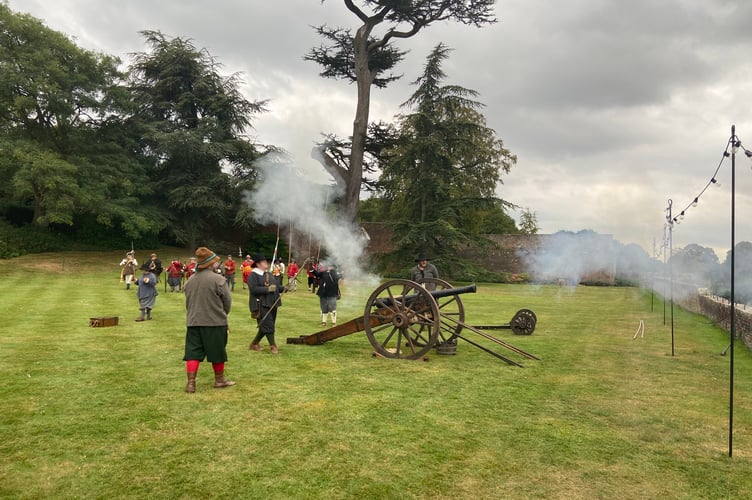
Something of a nationwide craze for historical pageants took hold at the beginning of the 20th century, writes Gillian David.
From about 1905 onwards, communities across England, Scotland and Wales staged theatrical re-enactments of events from local and national history that involved large sections of the population as performers, organisers and spectators.
Not to be left out, in 1910 Farnham staged its very own highly successful pageant entitled "Farnham Historical Episodes". This was the first of many pageants devised by the Rev Neville Lovett, rector of Farnham and future Bishop of Salisbury and Portsmouth.
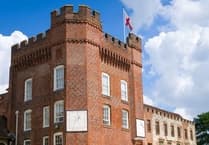
Three hundred local townspeople took part, depicting scenes from the history of the Castle starting with Henri of Blois in 1147 through to the arrival of Bishop Sumner in 1828. For the Herald there were two scenes of particular note.


The first had 'evil' King John being outwitted by the Bishop of Winchester, Peter des Roches, who persuaded him to grant Farnham a town charter, which reduced the taxes paid by the people of Farnham, allowing trade to flourish. According to the newspaper, this episode was "without hesitation…the best entertainment ever given in Farnham".
The final scene in the pageant also drew praise for its depiction of the clash of political ideas between the more reactionary Bishop Sumner, who had voted against the 1832 Great Reform Act, and the radicalism of Farnham’s most famous son, William Cobbett, who advocated an expansion of the franchise and a more representative House of Commons.
Other scenes include the arrival of Prince Arthur, infant son of Henry VII, who spent his first 7 years at the Castle under the care of Blind Bishop Fox. Cardinal Wolsey, as Bishop of Winchester, also put in a brief appearance before being summoned to his execution by Henry VIII. Elizabeth I featured in two scenes; in one she is discussing finding a suitable husband, and in the second her victory over the Spanish Armada is celebrated by a service of thanksgiving conducted by the bishop.
The Castle was in parliamentary hands throughout the English Civil War, but nevertheless Charles I put in an appearance, as he did in reality, as a guest of Sir Henry Vernon, who offers him a place to stay in December 1648, when the Castle refused to lodge him, en route to his execution in London a month later.
The Farnham Pageant was performed five times over the weekend, culminating in a huge torchlit procession all the way down Castle Street to Church House on Union Road. It raised £300, which went towards paying off the remaining £800 debt on the construction of Church House, whose idea had also been the brainchild of Mr Lovett, and why he presumably felt an obligation to find the remaining funds. Church House was opened in November 1909 by the Duchess of Albany, sister-in-law of King Edward VII.
Farnham’s pageant differed from ones held in other parts of the country, including Bath and Winchester, because it did not seek to exaggerate the importance of the town. Instead, it avoided Edwardian hyperbole in favour of an emphasis on more local characteristics, and proved to be a model for other town pageants following the First World War.
Evidence of the success of the 1910 pageant is the fact that others took place in Farnham in 1930, 1950 and 1988, but it was the one in 1910 that set the benchmark.
Dr Ealand, who played Henry de Blois, looked forward to the year 2010 when he dared to conjecture that Farnham had the pluck to again put "Historical Episodes" before the people—and they must not expect to do it before that, because they could not expect to find a rector of Farnham equal to theirs within 100 years.
He suggested that the eleventh episode would depict Mr Lovett and a recreation of early 20th century life "in order that their successors might know what justice they of Farnham in the year 1910 could do to good old August 1 to 3, 1910". Praise indeed!
Comments
We've recently changed our login process. If you have an account for commenting, you will need to re-register on the login window.
This article has no comments yet. Be the first to leave a comment.